
Review the key concepts, formulae, and examples before starting your quiz.
🔑Concepts
The Basic Proportionality Theorem (Thales' Theorem) states that if a line is drawn parallel to one side of a triangle to intersect the other two sides in distinct points, the other two sides are divided in the same ratio. In , if , then .
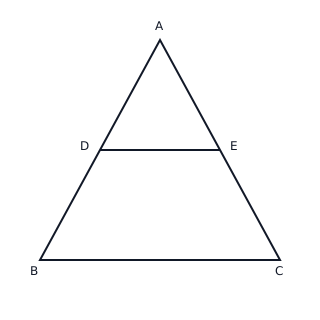
The Converse of BPT states that if a line divides any two sides of a triangle in the same ratio, then the line is parallel to the third side. If , then .
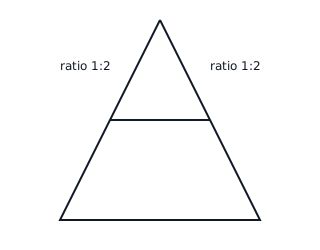
Corollaries of BPT: The ratios can also be expressed comparing parts to the whole side: and . This is useful when the full length of a side is known.
Internal Bisector Theorem: A special application related to proportionality where the internal bisector of an angle of a triangle divides the opposite side in the ratio of the sides containing the angle.
📐Formulae
Basic Proportionality Theorem:
Converse of BPT: If , then
Corollary 1 (Whole side to upper segment):
Corollary 2 (Whole side to lower segment):
Extended Ratio (Similarity):
💡Examples
Problem 1:
In , . If cm, cm, and cm, find the length of .
Solution:
Given , by Basic Proportionality Theorem: Substitute the given values: Simplify the fraction on the left: Cross-multiplying gives:
Explanation:
We use the direct ratio provided by Thales' Theorem because the line is parallel to the base and we need to find a segment on one of the divided sides.
Problem 2:
In , . If , , , and , find the value of .
Solution:
Using BPT: Substitute the algebraic expressions: Cross-multiply to solve for : Subtract from both sides:
Explanation:
This problem applies BPT to solve an algebraic equation. Note that simplifies to using the identity .
Problem 3:
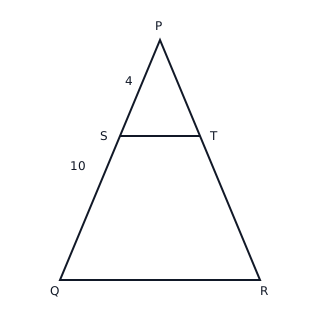
In the given figure, . If cm, cm, and cm, find the length of .
Solution:
- Identify the given values: cm, cm.
- Calculate cm.
- By Basic Proportionality Theorem, since , .
- Alternatively, use the corollary: .
- Substituting the values: .
- .
- cm.
Explanation:
We use the corollary of the Basic Proportionality Theorem which relates the upper segment of the side to the total length of the side.
Problem 4:
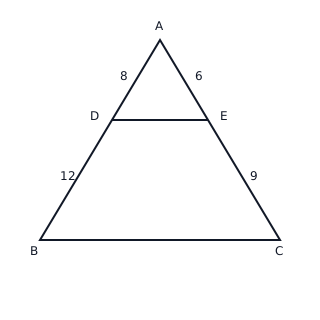
In , and are points on sides and respectively such that cm, cm, cm and cm. Prove that .
Solution:
- Calculate the ratio of segments on side : .
- Calculate the ratio of segments on side : .
- Compare the ratios: Since , the line divides the two sides and in the same ratio.
- By the Converse of Basic Proportionality Theorem, must be parallel to .
Explanation:
This problem applies the Converse of BPT. Since the ratios of the split segments are equal, the line creating the split is parallel to the base.