
Review the key concepts, formulae, and examples before starting your quiz.
🔑Concepts
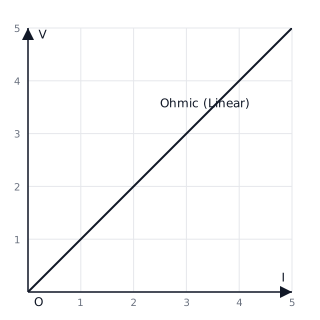
Ohm's Law states that the current flowing through a conductor is directly proportional to the potential difference across its ends, provided physical conditions like temperature remain constant. Devices that follow this linear relationship () are called ohmic conductors.
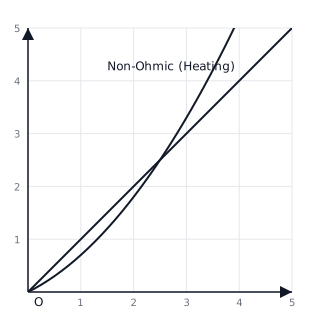
Non-ohmic behavior occurs when the relationship is non-linear. One common limitation is the heating effect: as current increases, the temperature of a conductor rises, causing its resistance to increase. Consequently, the graph curves away from the straight line at high currents.
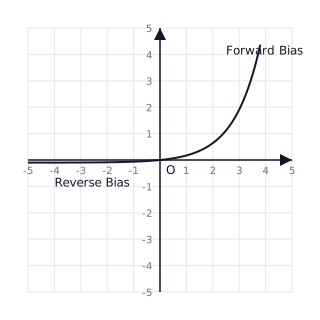
The relationship between and may depend on the sign of . In devices like a p-n junction diode, a small forward voltage allows significant current, but reversing the polarity results in very little current until breakdown occurs.
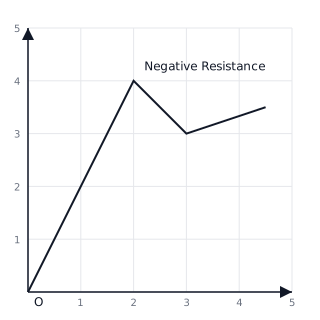
Some materials, like Gallium Arsenide (GaAs), exhibit a region where current decreases as voltage increases. This is known as the 'negative resistance' region, which is a significant departure from Ohm's Law.
📐Formulae
💡Examples
Problem 1:
In a certain semiconductor device, the current increases from to when the voltage is increased from to . Calculate the dynamic resistance in this region.
Solution:
Given: and . Using the formula for dynamic resistance:
Explanation:
The dynamic resistance is calculated as the ratio of a small change in voltage to the resulting change in current, which is useful for non-ohmic devices where the slope is not constant.
Problem 2:
A student plots a graph for a metallic wire at two different temperatures and . The graph for has a steeper slope (where is on the y-axis and is on the x-axis) than . Which temperature is higher?
Solution:
The slope of a graph represents the resistance . Since the slope for is greater than the slope for , it implies . For metals, resistance increases with temperature according to . Therefore, .
Explanation:
This demonstrates how Ohm's law fails to remain constant when temperature changes, leading to different resistance values for the same material.
Problem 3:
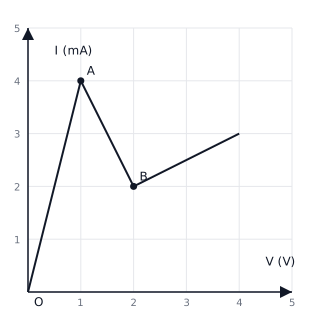
Identify the region in the given characteristic of a tunnel diode where the device exhibits negative dynamic resistance. If at point A the voltage is and current is , and at point B the voltage is and current is , calculate the dynamic resistance for this region.
Solution:
- Negative dynamic resistance occurs where current decreases as voltage increases.
- Change in voltage .
- Change in current .
- Dynamic resistance
- .
Explanation:
The negative sign in the resistance value indicates that the potential difference and current changes are in opposite directions, characteristic of the negative resistance region in semiconductors.
Problem 4:
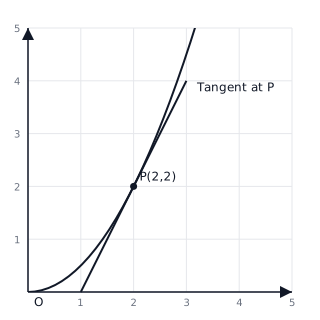
A non-ohmic resistor has a characteristic defined by the curve shown. If the current through the resistor is , find the dynamic resistance at that point using the graph where .
Solution:
- Given the relation .
- To find dynamic resistance , we differentiate with respect to : .
- .
- At , .
Explanation:
For non-linear devices, resistance is not a constant value. The dynamic resistance is the slope of the curve at a specific point, calculated as the derivative of the voltage function with respect to current.