
Review the key concepts, formulae, and examples before starting your quiz.
🔑Concepts
Ohm's Law states that the current () flowing through a conductor is directly proportional to the potential difference () applied across its ends, provided temperature and other physical conditions remain constant: . This linear relationship can be visualized on a graph where the slope represents the resistance .
Drift Velocity () is the average velocity attained by free electrons in a conductor due to an applied electric field. In the absence of a field, electrons move randomly with high thermal speeds (approx. ), but their net displacement is zero. Under an electric field, they drift slowly (approx. ) against the field direction.
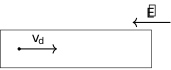
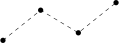
Relaxation Time () is the average time interval between two successive collisions of a free electron with the positive ions of the lattice. It decreases as temperature increases because thermal vibrations of ions increase, leading to more frequent collisions.
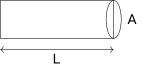
Electrical Resistivity () is an intrinsic property of a material. While resistance depends on geometry ( and ), resistivity depends only on the nature of the material and its temperature. It is defined as .
📐Formulae
💡Examples
Problem 1:
A potential difference of is applied across a conductor of length . If the drift velocity of electrons is , calculate the mobility of the electrons.
Solution:
Given: , , . \nFirst, find the Electric Field: . \nMobility .
Explanation:
Mobility is defined as the drift velocity acquired per unit electric field applied. We first derive the field from the potential and length.
Problem 2:
A wire of resistance is stretched to triple its original length. What will be its new resistance, assuming density and resistivity remain constant?
Solution:
Let initial length be and area be . Volume is constant. \nWhen , the new area must satisfy . \nInitial Resistance . \nNew Resistance .
Explanation:
Resistance depends on the geometry of the conductor. When a wire is stretched, its length increases and its cross-sectional area decreases such that the total volume remains the same. The resistance increases by the square of the stretching factor.
Problem 3:
Calculate the current density in a copper wire of radius when a current of flows through it. Also, determine the drift velocity if the number density of free electrons is .

Solution:
- Area of cross-section .
- Current density .
- Drift velocity .
- .
Explanation:
Current density is current per unit area. Drift velocity is then derived from the relationship .
Problem 4:
A potential difference of is applied across a conductor of length and resistance . If the relaxation time is , find the electron mobility . (Take )

Solution:
- Mobility .
- .
- .
Explanation:
Mobility is defined as the magnitude of drift velocity per unit electric field. It depends only on the charge of the charge of the carrier, relaxation time, and mass.