
Review the key concepts, formulae, and examples before starting your quiz.
🔑Concepts
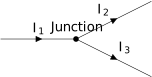
Kirchhoff's First Rule (Junction Rule): This rule is based on the Law of Conservation of Charge. It states that the algebraic sum of currents meeting at any junction in a circuit is zero (). In other words, the sum of currents entering a junction equals the sum of currents leaving it.
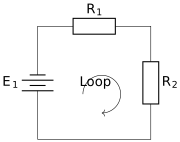
Kirchhoff's Second Rule (Loop Rule): This rule is based on the Law of Conservation of Energy. It states that the algebraic sum of changes in potential around any closed loop in a circuit must be zero ().
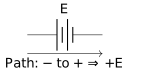
Sign Convention for EMF: The EMF () is taken as positive if we traverse from the negative terminal to the positive terminal inside the cell, and negative if we move from positive to negative.
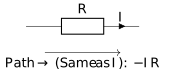
Sign Convention for Potential Drop (): The potential change is taken as negative () if we move in the direction of the current, and positive () if we move against the current direction.
📐Formulae
💡Examples
Problem 1:
Consider a simple closed loop containing a battery of and two resistors and connected in series. Find the current flowing through the circuit using Kirchhoff's Loop Rule.
Solution:
Let the current in the loop be . Starting from the negative terminal of the battery and traversing clockwise:
Explanation:
According to the Loop Rule, the sum of the EMFs and potential drops must be zero. Since we move from the negative to the positive terminal of the cell, is . Since we move in the direction of the current through the resistors, the potential changes are and .
Problem 2:
At a junction in an electrical circuit, four wires meet. Current flows towards the junction, flows away, and flows towards the junction. Find the magnitude and direction of the current in the fourth wire.
Solution:
Applying Kirchhoff's Junction Rule: . Let be directed away from the junction.
Explanation:
By the conservation of charge, the total current entering () must equal the total current leaving (). Solving for gives flowing away from the junction.
Problem 3:
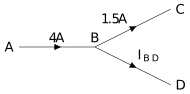
In a bridge circuit segment, three currents meet at junction . If (entering ) and (leaving towards ), find the current leaving junction towards .
Solution:
Applying Kirchhoff's Junction Rule at point : The current flowing through branch is .
Explanation:
According to the Junction Rule, charge cannot accumulate at a point. Therefore, the total current entering junction must be distributed among the outgoing branches.
Problem 4:
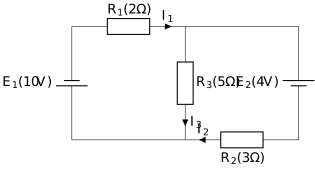
In the given two-mesh circuit, find the currents , , and using Kirchhoff's rules. The circuit consists of two batteries and , and three resistors , , and . Current flows from through , flows from through , and is the sum flowing through .
Solution:
Applying Kirchhoff's First Rule at the junction:
Applying Kirchhoff's Second Rule to Loop 1 (clockwise):
Applying Kirchhoff's Second Rule to Loop 2 (counter-clockwise):
Solving the simultaneous equations: Multiply Eq. 1 by 8 and Eq. 2 by 5:
Subtracting the equations:
Substituting into Eq. 1:
Finally:
Explanation:
We use the Junction Rule to relate the three branch currents. Then, we apply the Loop Rule to the two independent loops. The negative sign for indicates that the actual current direction is opposite to the one assumed in the diagram.