
Review the key concepts, formulae, and examples before starting your quiz.
🔑Concepts
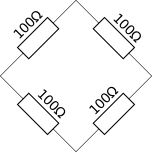
The Wheatstone bridge is an electrical circuit used to measure an unknown electrical resistance by balancing two legs of a bridge circuit, one leg of which includes the unknown component.
The bridge is in a 'balanced' state when the potential difference across the galvanometer is zero, meaning no current flows through it (). This occurs when the ratio of resistances in the two arms is equal: .
The Meter Bridge is a practical application of the Wheatstone bridge. It uses a wire of uniform cross-section (usually 1 meter long) where the ratio of resistances is replaced by the ratio of lengths and because resistance is proportional to length ().
Sensitivity of the Wheatstone bridge is maximum when all four resistances , , , and are of the same order of magnitude. This ensures a significant change in galvanometer deflection for a small change in the unknown resistance.
📐Formulae
💡Examples
Problem 1:
In a Wheatstone bridge, the four arms have resistances , , , and is unknown. If the bridge is balanced, calculate the value of .
Solution:
Given: , , . Using the balance condition , we have: .
Explanation:
The balanced Wheatstone bridge condition states that the product of opposite arm resistances is equal, or the ratios of adjacent arms are equal. Here, we solve for the unknown arm by substituting the known values into the ratio formula.
Problem 2:
In a Meter Bridge experiment, the null point is found at a distance of from end when a resistance is connected in the left gap. Find the value of the unknown resistance in the right gap.
Solution:
Given: , . The length of the remaining wire is . Using the formula : .
Explanation:
The Meter Bridge works on the principle of the Wheatstone bridge. The ratio of the resistances in the two gaps equals the ratio of the lengths of the two segments of the wire at the balance point.
Problem 3:
In the given Wheatstone bridge circuit, the resistances in the arms are , , and . A galvanometer is connected between points and . Determine the value of the unknown resistance required to balance the bridge and find the current through the galvanometer when the bridge is balanced.
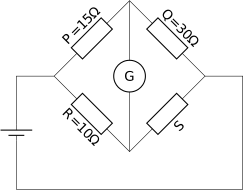
Solution:
For a Wheatstone bridge to be balanced, the condition is given by:
Substituting the given values:
When the bridge is balanced, the potential at point is equal to the potential at point (). Therefore, the potential difference across the galvanometer is zero, and the current through it is:
Explanation:
The balancing condition ensures that no current flows through the central arm (galvanometer). This happens when the ratio of resistances in the upper arms equals the ratio of resistances in the lower arms.
Problem 4:
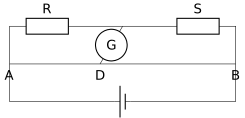
A Meter Bridge is used to find an unknown resistance . When a standard resistor is placed in the left gap, the null point is obtained at from the left end . Calculate the value of the unknown resistance in the right gap. If the positions of and are interchanged, what will be the new balancing length from end ?
Solution:
For a Meter Bridge, the balancing condition is:
Given and :
When and are interchanged, let the new balance length be . The condition becomes:
Explanation:
The Meter Bridge works on the principle of the Wheatstone bridge. The resistance of the wire is proportional to its length, so the ratio of resistances equals the ratio of the lengths of the two segments of the wire.