krit.club logo

Current Electricity - Combination of Cells in Series and Parallel

Grade 12CBSEPhysics

Review the key concepts, formulae, and examples before starting your quiz.

🔑Concepts

•

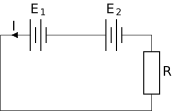
Cells in series are connected end-to-end such that the same current flows through each cell. When nn identical cells each of EMF EE and internal resistance rr are connected in series, the total EMF is nEnE and total internal resistance is nrnr. This configuration is used to increase the voltage across an external load RR.

Circuit diagram showing two cells connected in series with an external resistor R.
•

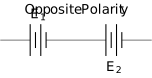
When cells are connected in series but with reversed polarity (opposing each other), the net EMF is the difference between the individual EMFs. For two cells E1E_1 and E2E_2 (where E1>E2E_1 > E_2) connected in opposition, the equivalent EMF is Eeq=E1−E2E_{eq} = E_1 - E_2, while the internal resistances always add up: req=r1+r2r_{eq} = r_1 + r_2.

Diagram showing two cells in series with opposing polarities.
•

In a parallel combination, the positive terminals of all cells are connected to one point and the negative terminals to another. For mm identical cells in parallel, the equivalent EMF EeqE_{eq} remains EE (the EMF of a single cell), but the equivalent internal resistance decreases to rm\frac{r}{m}. This arrangement is beneficial when the external resistance is very low.
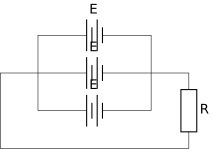
Circuit diagram showing three identical cells connected in parallel across an external resistor R.
•

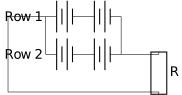
For a mixed grouping of cells (a combination of series and parallel), maximum current is delivered to an external resistor RR when the external resistance is equal to the total internal resistance of the battery bank, i.e., R=nrmR = \frac{nr}{m}, where nn is the number of cells in series and mm is the number of parallel rows.

Mixed grouping of cells with two rows in parallel, each containing two cells in series.

📐Formulae

Eeq=E1+E2+⋯+En (Series combination)E_{eq} = E_1 + E_2 + \dots + E_n \text{ (Series combination)}

req=r1+r2+⋯+rn (Series combination internal resistance)r_{eq} = r_1 + r_2 + \dots + r_n \text{ (Series combination internal resistance)}

I=∑E∑r+R (Current in series loop)I = \frac{\sum E}{\sum r + R} \text{ (Current in series loop)}

Eeqreq=E1r1+E2r2+⋯+Enrn (Parallel equivalent EMF)\frac{E_{eq}}{r_{eq}} = \frac{E_1}{r_1} + \frac{E_2}{r_2} + \dots + \frac{E_n}{r_n} \text{ (Parallel equivalent EMF)}

1req=1r1+1r2+⋯+1rn (Parallel equivalent resistance)\frac{1}{r_{eq}} = \frac{1}{r_1} + \frac{1}{r_2} + \dots + \frac{1}{r_n} \text{ (Parallel equivalent resistance)}

Eeq=E1r2+E2r1r1+r2 (Equivalent EMF for two cells in parallel)E_{eq} = \frac{E_1 r_2 + E_2 r_1}{r_1 + r_2} \text{ (Equivalent EMF for two cells in parallel)}

req=r1r2r1+r2 (Equivalent internal resistance for two cells in parallel)r_{eq} = \frac{r_1 r_2}{r_1 + r_2} \text{ (Equivalent internal resistance for two cells in parallel)}

💡Examples

Problem 1:

Two cells of EMF 2 V2\text{ V} and 4 V4\text{ V} with internal resistances 1 Ω1\text{ }\Omega and 2 Ω2\text{ }\Omega respectively are connected in parallel. Calculate the equivalent EMF and equivalent internal resistance of the combination.

Solution:

Given: E1=2 VE_1 = 2\text{ V}, r1=1 Ωr_1 = 1\text{ }\Omega, E2=4 VE_2 = 4\text{ V}, r2=2 Ωr_2 = 2\text{ }\Omega. Using the parallel formula for equivalent EMF: Eeq=E1r2+E2r1r1+r2E_{eq} = \frac{E_1 r_2 + E_2 r_1}{r_1 + r_2} Eeq=(2×2)+(4×1)1+2=4+43=83 V≈2.67 VE_{eq} = \frac{(2 \times 2) + (4 \times 1)}{1 + 2} = \frac{4 + 4}{3} = \frac{8}{3}\text{ V} \approx 2.67\text{ V} Using the parallel formula for equivalent internal resistance: req=r1r2r1+r2r_{eq} = \frac{r_1 r_2}{r_1 + r_2} req=1×21+2=23 Ω≈0.67 Ωr_{eq} = \frac{1 \times 2}{1 + 2} = \frac{2}{3}\text{ }\Omega \approx 0.67\text{ }\Omega

Explanation:

In a parallel combination of non-identical cells, the equivalent EMF is a weighted average of the individual EMFs, weighted by the reciprocal of their internal resistances. The equivalent resistance follows the standard parallel law for resistors.

Problem 2:

Four identical cells each of EMF 1.5 V1.5\text{ V} and internal resistance 0.5 Ω0.5\text{ }\Omega are connected in series to an external resistor of 8 Ω8\text{ }\Omega. Find the current flowing in the circuit.

Solution:

Given: n=4n = 4, E=1.5 VE = 1.5\text{ V}, r=0.5 Ωr = 0.5\text{ }\Omega, R=8 ΩR = 8\text{ }\Omega. Total EMF Etotal=nE=4×1.5=6 VE_{total} = nE = 4 \times 1.5 = 6\text{ V}. Total internal resistance rtotal=nr=4×0.5=2 Ωr_{total} = nr = 4 \times 0.5 = 2\text{ }\Omega. Total circuit resistance Rtotal=R+nr=8+2=10 ΩR_{total} = R + nr = 8 + 2 = 10\text{ }\Omega. Current I=EtotalRtotalI = \frac{E_{total}}{R_{total}}: I=610=0.6 AI = \frac{6}{10} = 0.6\text{ A}

Explanation:

When cells are in series, their EMFs and internal resistances are simply added. The current is then calculated using Ohm's law for the complete circuit including the external load.

Problem 3:

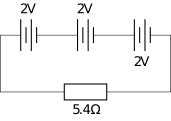
Three identical cells, each of EMF 2 V2\text{ V} and internal resistance 0.2 Ω0.2\text{ }\Omega, are connected in series. However, one cell is accidentally connected with reversed polarity. Calculate the net EMF and the current in the circuit if an external resistor of 5.4 Ω5.4\text{ }\Omega is used.

Circuit diagram showing three cells in series with the third cell having reversed polarity.

Solution:

  1. Identify parameters: n=3n = 3, E=2 VE = 2\text{ V}, r=0.2 Ωr = 0.2\text{ }\Omega, R=5.4 ΩR = 5.4\text{ }\Omega.
  2. Since one cell is reversed, net EMF Enet=(n−2nreversed)E=(3−2(1))×2=1×2=2 VE_{net} = (n - 2n_{reversed})E = (3 - 2(1)) \times 2 = 1 \times 2 = 2\text{ V}.
  3. Total internal resistance rtotal=n×r=3×0.2=0.6 Ωr_{total} = n \times r = 3 \times 0.2 = 0.6\text{ }\Omega.
  4. Total resistance Rtotal=R+rtotal=5.4+0.6=6.0 ΩR_{total} = R + r_{total} = 5.4 + 0.6 = 6.0\text{ }\Omega.
  5. Current I=EnetRtotal=26=0.33 AI = \frac{E_{net}}{R_{total}} = \frac{2}{6} = 0.33\text{ A}.

Explanation:

Even though a cell is reversed, its internal resistance still contributes to the total resistance of the circuit. The reversed EMF opposes the EMF of one of the correctly connected cells, effectively canceling it out.

Problem 4:

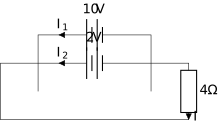
Two cells of EMF 10 V10\text{ V} and 2 V2\text{ V} with internal resistances 2 Ω2\text{ }\Omega and 1 Ω1\text{ }\Omega respectively are connected in parallel with their like terminals together. Calculate the current through an external resistor of 4 Ω4\text{ }\Omega.

Circuit diagram showing two different cells in parallel connected to a 4 ohm resistor.

Solution:

  1. Calculate equivalent EMF EeqE_{eq}: Eeq=E1r2+E2r1r1+r2E_{eq} = \frac{E_1 r_2 + E_2 r_1}{r_1 + r_2} Eeq=(10×1)+(2×2)2+1=10+43=143 V≈4.67 VE_{eq} = \frac{(10 \times 1) + (2 \times 2)}{2 + 1} = \frac{10 + 4}{3} = \frac{14}{3}\text{ V} \approx 4.67\text{ V}
  2. Calculate equivalent internal resistance reqr_{eq}: req=r1r2r1+r2=2×12+1=23 Ω≈0.67 Ωr_{eq} = \frac{r_1 r_2}{r_1 + r_2} = \frac{2 \times 1}{2 + 1} = \frac{2}{3}\text{ }\Omega \approx 0.67\text{ }\Omega
  3. Total resistance of circuit Rtot=R+req=4+23=143 ΩR_{tot} = R + r_{eq} = 4 + \frac{2}{3} = \frac{14}{3}\text{ }\Omega.
  4. Current I=EeqRtot=14/314/3=1 AI = \frac{E_{eq}}{R_{tot}} = \frac{14/3}{14/3} = 1\text{ A}.

Explanation:

When cells of different EMFs are in parallel, the equivalent EMF is a weighted average based on internal resistances. The equivalent resistance is found using the parallel resistor formula.