krit.club logo

Geometry - Scale Drawings

Grade 9IGCSE

Review the key concepts, formulae, and examples before starting your quiz.

🔑Concepts

•

The scale of a drawing is a ratio that compares the dimensions of the drawing to the actual size of the object. It is usually written in the form 1:n1 : n, which means that 11 unit on the drawing represents nn units in real life. All units must be identical before simplifying the ratio.
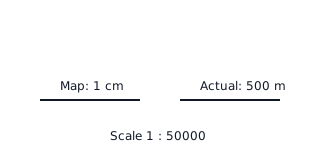
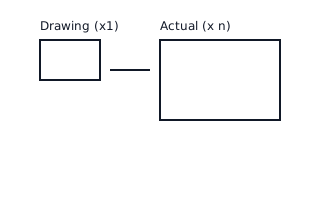
Comparison between a 1 cm map line and a 500 m actual distance to illustrate scale factor.
•

To calculate the actual length, multiply the drawing length by the scale factor nn. For example, if the scale is 1:20001 : 2000, an 8 cm8 \text{ cm} line on paper represents 8×2000=16,000 cm8 \times 2000 = 16,000 \text{ cm}, which is 160 m160 \text{ m}.

Geometric representation of enlargement from drawing to reality using linear scale factor.
•

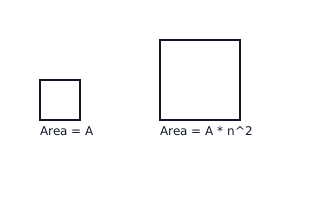
When working with areas, the scale factor must be squared. If the linear scale is 1:n1 : n, then the area scale is 1:n21 : n^2. This is because both the length and the width of the shape are scaled by nn.

Comparison of two squares showing that doubling side length quadruples the area.
•

Unit conversion is a critical step. Common conversions include: 1 km=1,000 m1 \text{ km} = 1,000 \text{ m}, 1 m=100 cm1 \text{ m} = 100 \text{ cm}, and 1 cm=10 mm1 \text{ cm} = 10 \text{ mm}. For area, remember 1 m2=10,000 cm21 \text{ m}^2 = 10,000 \text{ cm}^2 and 1 km2=1,000,000 m21 \text{ km}^2 = 1,000,000 \text{ m}^2.

•

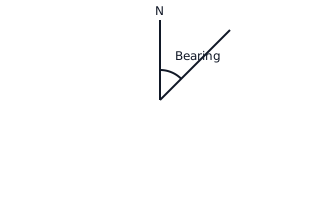
Bearings are often combined with scale drawings. A bearing is an angle measured clockwise from the North line, expressed as a three-digit number (e.g., 045∘045^{\circ}).

A diagram showing a North line and an angle measured clockwise to indicate a bearing.

📐Formulae

Scale=Length on MapActual Length\text{Scale} = \frac{\text{Length on Map}}{\text{Actual Length}}

Actual Length=Length on Map×Scale Factor\text{Actual Length} = \text{Length on Map} \times \text{Scale Factor}

Actual Area=Area on Map×(Scale Factor)2\text{Actual Area} = \text{Area on Map} \times (\text{Scale Factor})^2

Area Scale=(Linear Scale)2\text{Area Scale} = (\text{Linear Scale})^2

💡Examples

Problem 1:

A map is drawn to a scale of 1:50,0001:50,000. If the distance between two villages on the map is 7.5 cm7.5 \text{ cm}, calculate the actual distance in km\text{km}.

Solution:

Step 1: Multiply the map distance by the scale factor. Actual distance in cm=7.5×50,000=375,000 cm\text{Actual distance in cm} = 7.5 \times 50,000 = 375,000 \text{ cm} Step 2: Convert centimeters to kilometers. Since 1 km=100,000 cm1 \text{ km} = 100,000 \text{ cm}: Actual distance in km=375,000100,000=3.75 km\text{Actual distance in km} = \frac{375,000}{100,000} = 3.75 \text{ km}

Explanation:

To find the real-world distance, we multiply the map distance by the scale ratio. Finally, we divide by 100,000100,000 to convert from centimeters to kilometers.

Problem 2:

A forest has an area of 12 km212 \text{ km}^2. On a map, the area of the forest is 3 cm23 \text{ cm}^2. Find the scale of the map in the form 1:n1:n.

Solution:

Step 1: Express the area ratio. Area Scale=3 cm2:12 km2\text{Area Scale} = 3 \text{ cm}^2 : 12 \text{ km}^2 Step 2: Simplify the area ratio to 1 unit21 \text{ unit}^2. 1 cm2:4 km21 \text{ cm}^2 : 4 \text{ km}^2 Step 3: Find the linear scale by taking the square root of both sides. 1 cm2:4 km2\sqrt{1 \text{ cm}^2} : \sqrt{4 \text{ km}^2} 1 cm:2 km1 \text{ cm} : 2 \text{ km} Step 4: Convert to the same units (1 km=100,000 cm1 \text{ km} = 100,000 \text{ cm}). 1:2×100,0001 : 2 \times 100,000 1:200,0001 : 200,000

Explanation:

Since map area relates to actual area by the square of the linear scale factor, we must take the square root of the simplified area ratio to find the linear scale, then ensure units are identical for the final ratio.

Problem 3:

Two points on a blueprint are 15.8 mm15.8 \text{ mm} apart. A third point is 6.3 mm6.3 \text{ mm} from the first. Calculate the difference in their drawing lengths and then find the actual difference in meters if the scale is 1:5001:500.

Solution:

Calculate the difference in drawing length: 15.8−6.39.5 mm\begin{array}{r} 15.8 \\ - 6.3 \\ \hline 9.5 \end{array} \text{ mm} Now, convert to actual distance: Actual difference in mm=9.5×500=4750 mm\text{Actual difference in mm} = 9.5 \times 500 = 4750 \text{ mm} Convert to meters (1 m=1000 mm1 \text{ m} = 1000 \text{ mm}): Actual difference in m=47501000=4.75 m\text{Actual difference in m} = \frac{4750}{1000} = 4.75 \text{ m}

Explanation:

First, subtract the blueprint measurements to find the difference in drawing length. Multiply this by the scale factor (500500) and convert to meters by dividing by 10001000.

Problem 4:

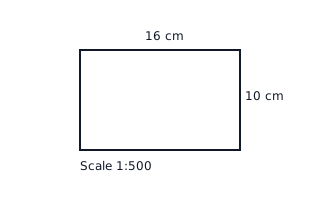
A rectangular playground measures 80 m80 \text{ m} by 50 m50 \text{ m}. A student makes a scale drawing of the playground using a scale of 1:5001:500. Calculate the dimensions of the playground on the drawing in cm\text{cm}.

Scale drawing of a rectangle with labeled dimensions 16cm and 10cm.

Solution:

Scale=1:500\text{Scale} = 1:500 Drawing Length=Actual LengthScale Factor\text{Drawing Length} = \frac{\text{Actual Length}}{\text{Scale Factor}} Length=80 m500=0.16 m\text{Length} = \frac{80 \text{ m}}{500} = 0.16 \text{ m} Width=50 m500=0.1 m\text{Width} = \frac{50 \text{ m}}{500} = 0.1 \text{ m} Converting to cm\text{cm}: Length in cm=0.16×100=16 cm\text{Length in cm} = 0.16 \times 100 = 16 \text{ cm} Width in cm=0.1×100=10 cm\text{Width in cm} = 0.1 \times 100 = 10 \text{ cm}

Explanation:

Divide the real-world dimensions by the scale factor. Then, multiply by 100 to convert meters to centimeters for the final drawing units.

Problem 5:

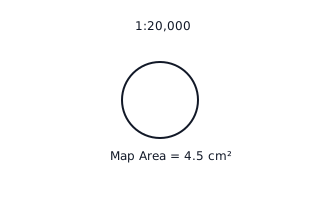
On a map with a scale of 1:20,0001:20,000, a circular lake has an area of 4.5 cm24.5 \text{ cm}^2. Calculate the actual area of the lake in square meters (m2m^2).

A circle representing a lake on a map with the area labeled as 4.5 square centimeters.

Solution:

Linear Scale Factor (n)=20,000\text{Linear Scale Factor } (n) = 20,000 Area Scale Factor=n2=(20,000)2=400,000,000\text{Area Scale Factor} = n^2 = (20,000)^2 = 400,000,000 Actual Area=4.5 cm2×400,000,000=1,800,000,000 cm2\text{Actual Area} = 4.5 \text{ cm}^2 \times 400,000,000 = 1,800,000,000 \text{ cm}^2 To convert cm2\text{cm}^2 to m2\text{m}^2, divide by 1002=10,000100^2 = 10,000: Actual Area in m2=1,800,000,00010,000=180,000 m2\text{Actual Area in } m^2 = \frac{1,800,000,000}{10,000} = 180,000 \text{ m}^2

Explanation:

First find the area scale factor by squaring the linear scale factor. Multiply the map area by this factor, then convert square centimeters to square meters by dividing by 10,000.