
Review the key concepts, formulae, and examples before starting your quiz.
🔑Concepts
When two parallel lines are cut by a transversal, corresponding angles are equal. They form an 'F' shape in the diagram.
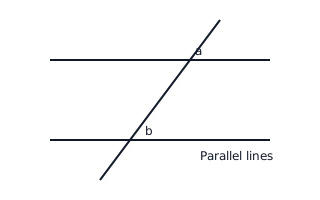
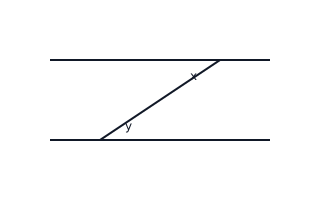
Alternate angles are equal. These are often called 'Z' angles and are located between parallel lines on opposite sides of the transversal.
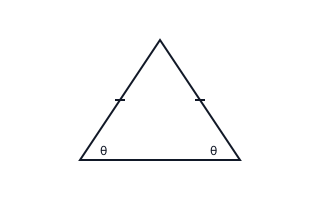
In an isosceles triangle, the angles opposite the equal sides are equal.
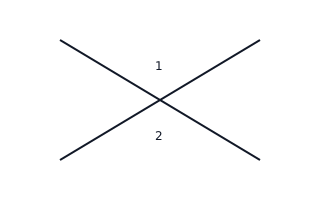
Vertically opposite angles are equal whenever two straight lines intersect.
📐Formulae
Angles on a line:
Sum of angles in a triangle:
Exterior angle of triangle:
Sum of angles in a quadrilateral:
Sum of interior angles of an -sided polygon:
Co-interior angles: (where lines are parallel)
💡Examples
Problem 1:
In triangle ABC, angle A is and angle B is . Calculate the exterior angle at vertex C.
Solution:
Explanation:
Using the exterior angle theorem, the exterior angle is equal to the sum of the two opposite interior angles. Therefore, Exterior .
Problem 2:
Two parallel lines are intersected by a transversal. If one of the co-interior angles is , find the value of the other co-interior angle.
Solution:
Explanation:
Co-interior (allied) angles between parallel lines are supplementary, meaning they add up to . Calculation: .
Problem 3:
A quadrilateral has three angles measuring , , and . Find the size of the fourth angle.
Solution:
Explanation:
The sum of angles in a quadrilateral is always . Sum of known angles: . Fourth angle: .
Problem 4:
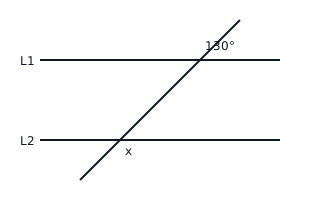
In the diagram below, and are parallel. Find the value of .
Solution:
- Identify the relationship: The angle and the angle adjacent to on the straight line are corresponding angles, or we can use alternate angles.
- The angle alternate to is .
- Since and the alternate angle lie on a straight line:
- Subtract from both sides:
Explanation:
We use the property that alternate angles are equal and then apply the property that angles on a straight line sum to .
Problem 5:
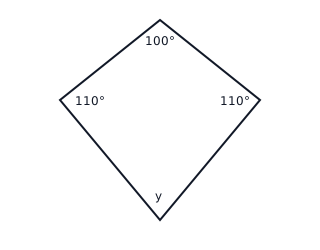
Find the value of in the following kite. One vertex angle is and the two equal opposite angles are each.
Solution:
- A kite is a quadrilateral, so the sum of interior angles is .
- Let the unknown angle be .
- Sum the known angles:
- Subtract from :
Explanation:
The sum of angles in any quadrilateral is . By subtracting the three known angles of the kite from , we find the missing angle.