
Review the key concepts, formulae, and examples before starting your quiz.
🔑Concepts
Congruent shapes are identical in size and shape. For triangles, four criteria guarantee congruence: SSS (Side-Side-Side), SAS (Side-Angle-Side), ASA (Angle-Side-Angle), and RHS (Right-Angle-Hypotenuse-Side).
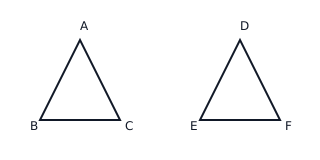
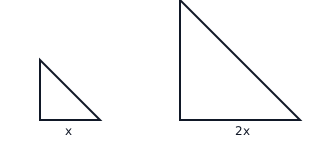
Similarity occurs when one shape is an enlargement of another. All corresponding angles are equal, and all corresponding sides are in the same ratio, known as the linear scale factor .
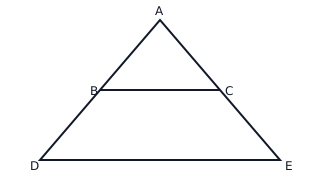
Parallel lines often create similar triangles through shared angles (AAA property). If a line is parallel to one side of a triangle, the smaller triangle created is similar to the original large triangle.
The relationship between length, area, and volume in similar figures follows the power rule: if the linear scale factor is , the area scale factor is and the volume scale factor is .
📐Formulae
💡Examples
Problem 1:
Triangle ABC is similar to Triangle DEF. In , cm and the area is cm². In , the corresponding side cm. Find the area of .
Solution:
180 cm²
Explanation:
First, find the linear scale factor . The area scale factor is . Therefore, cm².
Problem 2:
Two similar cylinders have heights of 5 cm and 10 cm. If the volume of the smaller cylinder is 50 cm³, find the volume of the larger cylinder.
Solution:
400 cm³
Explanation:
The linear scale factor . The volume scale factor is . The volume of the larger cylinder is cm³.
Problem 3:
In , a line is drawn parallel to such that is on and is on . If cm, cm, and cm, find the length of .
Solution:
9 cm
Explanation:
Because , is similar to (AA criterion). The length of cm. The scale factor . Therefore, cm.
Problem 4:
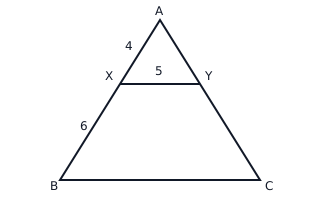
In the diagram, is parallel to . If cm, cm, and cm, calculate the length of .
Solution:
- Identify the similar triangles: because .
- Determine the side lengths of the larger triangle: cm.
- Find the linear scale factor : .
- Calculate : cm.
Explanation:
Since the lines are parallel, corresponding angles are equal, making the triangles similar. We use the ratio of the full side to the small side to find the scale factor.
Problem 5:
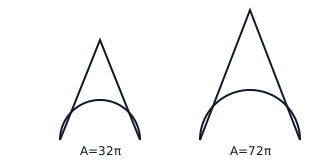
Two mathematically similar solid cones have surface areas of cm and cm. If the smaller cone has a volume of cm, find the volume of the larger cone.
Solution:
- Find the area scale factor: .
- Find the linear scale factor : .
- Find the volume scale factor: .
- Calculate the volume of the larger cone: cm.
Explanation:
To move from area to volume, you must first find the linear scale factor by taking the square root of the area ratio, then cube that linear factor to find the volume ratio.