krit.club logo

Geometry - Circle Theorems

Grade 9IGCSE

Review the key concepts, formulae, and examples before starting your quiz.

🔑Concepts

•

The angle subtended by an arc at the center of a circle is twice the angle subtended by it at any point on the remaining part of the circumference. This is often called the 'Arrowhead' or 'Angle at Center' theorem.
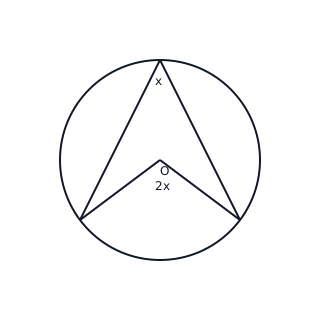
Diagram showing the angle at the center (2x) is twice the angle at the circumference (x).
•

Angles in the same segment (subtended by the same arc) are equal. This creates a 'bow-tie' shape within the circle.
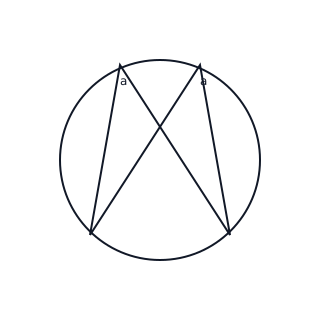
Diagram showing two equal angles subtended by the same chord in the same segment.
•

The angle in a semicircle is always a right angle (90∘90^\circ). Any triangle drawn from the diameter to the circumference will be right-angled.
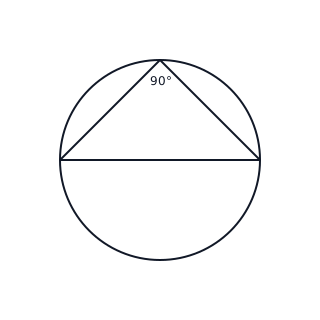
Diagram showing a triangle inscribed in a semicircle with a 90 degree angle at the circumference.
•

The Alternate Segment Theorem states that the angle between a tangent and a chord through the point of contact is equal to the angle in the alternate segment.

•

A radius and a tangent meet at right angles (90∘90^\circ) at the point of contact.

📐Formulae

Angle at Center=2×Angle at Circumference\text{Angle at Center} = 2 \times \text{Angle at Circumference}

∠A+∠C=180∘ (Opposite angles of cyclic quadrilateral)\angle A + \angle C = 180^\circ \text{ (Opposite angles of cyclic quadrilateral)}

Arc Length=θ360×2πr\text{Arc Length} = \frac{\theta}{360} \times 2\pi r

Sector Area=θ360×πr2\text{Sector Area} = \frac{\theta}{360} \times \pi r^2

Area of Segment=θ360πr2−12r2sin⁡(θ)\text{Area of Segment} = \frac{\theta}{360}\pi r^2 - \frac{1}{2}r^2\sin(\theta)

💡Examples

Problem 1:

Points A, B, and C lie on a circle with center O. If the angle AOC at the center is 130°, find the angle ABC at the circumference.

Solution:

65°

Explanation:

According to the Angle at the Center Theorem, the angle subtended at the center is twice the angle at the circumference. Therefore, ∠ABC=12×∠AOC=1302=65∘\angle ABC = \frac{1}{2} \times \angle AOC = \frac{130}{2} = 65^\circ.

Problem 2:

ABCD is a cyclic quadrilateral. If ∠DAB=115°\angle DAB = 115°, calculate the size of ∠BCD\angle BCD.

Solution:

65°

Explanation:

In a cyclic quadrilateral, opposite angles are supplementary (sum to 180°). Thus, ∠BCD=180∘−115∘=65∘\angle BCD = 180^\circ - 115^\circ = 65^\circ.

Problem 3:

A tangent PT touches a circle at point T. O is the center of the circle. If OT = 5 cm and OP = 13 cm, find the length of the tangent segment PT.

Solution:

12 cm

Explanation:

The radius OT is perpendicular to the tangent PT, forming a right-angled triangle OTP. Using Pythagoras' theorem: PT2+OT2=OP2⇒PT2+52=132⇒PT2=169−25=144PT^2 + OT^2 = OP^2 \Rightarrow PT^2 + 5^2 = 13^2 \Rightarrow PT^2 = 169 - 25 = 144. Therefore, PT=144=12PT = \sqrt{144} = 12 cm.

Problem 4:

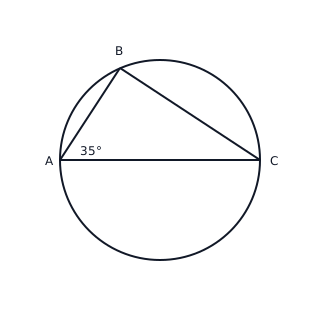
In the circle with center OO, ACAC is a diameter. Point BB lies on the circumference such that ∠BAC=35∘\angle BAC = 35^\circ. Calculate the size of ∠BCA\angle BCA.

Triangle ABC inscribed in a circle with AC as the diameter and angle A marked as 35 degrees.

Solution:

∠ABC=90∘ (Angle in a semicircle)\angle ABC = 90^\circ \text{ (Angle in a semicircle)} ∠BCA=180∘−(90∘+35∘)\angle BCA = 180^\circ - (90^\circ + 35^\circ) ∠BCA=180∘−125∘\angle BCA = 180^\circ - 125^\circ ∠BCA=55∘\angle BCA = 55^\circ

Explanation:

Since ACAC is a diameter, the angle it subtends at the circumference (angleABC\\angle ABC) must be 90∘90^\circ. By using the sum of angles in triangle ABCABC, we find the remaining angle.

Problem 5:

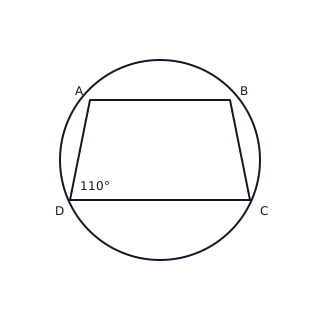
Points AA, BB, CC, and DD lie on a circle. ABAB is parallel to DCDC. If ∠ADC=110∘\angle ADC = 110^\circ, find ∠BCD\angle BCD.

Cyclic quadrilateral ABCD with AB parallel to DC and angle D marked as 110 degrees.

Solution:

ABCD is a cyclic quadrilateral.ABCD \text{ is a cyclic quadrilateral.} ∠ABC=180∘−110∘=70∘ (Opposite angles of cyclic quad)\angle ABC = 180^\circ - 110^\circ = 70^\circ \text{ (Opposite angles of cyclic quad)} Since AB∥DC,∠BCD+∠ABC=180∘ (Co-interior angles)\text{Since } AB \parallel DC, \angle BCD + \angle ABC = 180^\circ \text{ (Co-interior angles)} ∠BCD=180∘−70∘=110∘\angle BCD = 180^\circ - 70^\circ = 110^\circ

Explanation:

First, use the property that opposite angles in a cyclic quadrilateral sum to 180∘180^\circ to find angleABC\\angle ABC. Then, use the property of parallel lines (co-interior angles) to find angleBCD\\angle BCD.