
Review the key concepts, formulae, and examples before starting your quiz.
🔑Concepts
A polygon is a closed 2D shape with straight sides. A regular polygon has all sides and all interior angles equal. The exterior angle is formed by extending one side of the polygon. At any vertex, the interior angle and the exterior angle sum to because they lie on a straight line.
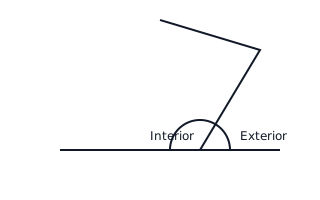
The sum of the exterior angles of any convex polygon is always . For a regular polygon with sides, each exterior angle is . This property is useful for finding the number of sides when the angle is known.
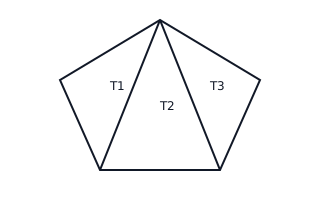
The sum of interior angles of a polygon with sides is . This is derived by dividing the polygon into triangles from a single vertex, where each triangle contributes .
Symmetry in polygons includes line symmetry (reflectional) and rotational symmetry. A regular polygon with sides has lines of symmetry and rotational symmetry of order .
📐Formulae
Sum of interior angles =
Individual interior angle of a regular polygon =
Sum of exterior angles =
Individual exterior angle of a regular polygon =
Interior angle + Exterior angle =
💡Examples
Problem 1:
Calculate the size of each interior angle of a regular decagon (10-sided polygon).
Solution:
144°
Explanation:
Using the formula for a regular polygon: . Alternatively, find the exterior angle first: , then subtract from 180: .
Problem 2:
A regular polygon has an exterior angle of 24°. How many sides does it have?
Solution:
15
Explanation:
The sum of exterior angles is always 360°. To find the number of sides , use the formula . Therefore, sides.
Problem 3:
Describe the symmetry of a rhombus.
Solution:
Line symmetry: 2; Rotational symmetry: Order 2
Explanation:
A rhombus has two lines of symmetry (the diagonals). It also has rotational symmetry of order 2 because it looks the same twice (at 180° and 360°) during a full rotation.
Problem 4:
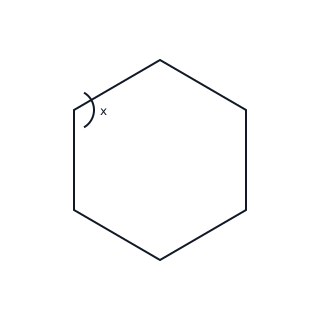
The diagram shows a regular hexagon. Calculate the value of the interior angle .
Solution:
- A hexagon has sides.
- Use the formula for the sum of interior angles: .
- Since it is a regular hexagon, all 6 interior angles are equal.
- .
Explanation:
To find the interior angle of a regular polygon, divide the total sum of angles by the number of vertices.
Problem 5:
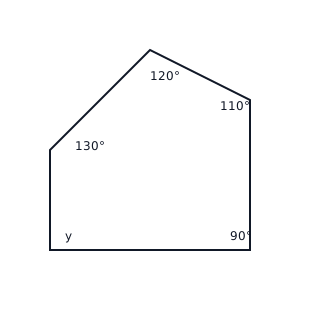
An irregular pentagon has four interior angles of , , , and . Find the size of the fifth interior angle .
Solution:
- A pentagon has sides.
- Sum of interior angles = .
- Sum of the known angles = .
- .
Explanation:
For any polygon, the sum of interior angles is constant based on the number of sides. Subtracting the known angles from this sum gives the missing value.