
Review the key concepts, formulae, and examples before starting your quiz.
🔑Concepts
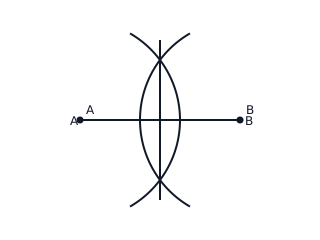
The perpendicular bisector of a line segment is the locus of all points that are equidistant from and . To construct it, draw two intersecting arcs of equal radius (greater than half of ) centered at and . The line passing through the intersections is the perpendicular bisector.
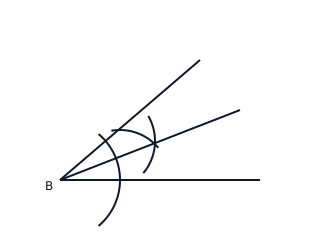
The angle bisector is the locus of points equidistant from two intersecting lines. To construct the bisector of , draw an arc centered at to intersect and . From these two intersection points, draw two more arcs of equal radius that intersect inside the angle. The line from through this intersection is the angle bisector.
The locus of points at a fixed distance from a point is a circle with center and radius . If the locus is restricted to points at a fixed distance from a line segment, it forms a 'stadium' shape consisting of two parallel lines and two semi-circles at the ends.
The locus of points equidistant from a fixed line consists of two parallel lines, one on each side of , at the specified distance .
📐Formulae
(Condition for Perpendicular Bisector)
(Condition for Angle Bisector)
(Locus of a circle centered at with radius )
💡Examples
Problem 1:
A map has two towns and which are apart. Construct the locus of points that are exactly from town and equidistant from towns and . Find how many such points exist.
Solution:
- Draw a line segment .
- Construct the perpendicular bisector of : Place the compass at , open to , and draw arcs above and below . Repeat from . Draw a line through the arc intersections.
- Construct the locus of points from : Use a compass to draw a circle with center and radius .
- The intersection points of the perpendicular bisector and the circle are the required points.
- Since the distance from the midpoint of to is and , the circle will intersect the perpendicular bisector at two distinct points.
Explanation:
The condition 'exactly from ' defines a circle. The condition 'equidistant from and ' defines the perpendicular bisector. The solution is the intersection of these two loci.
Problem 2:
Construct a angle at point on line segment .
Solution:
- At point , construct a perpendicular line to to create a angle.
- To do this, extend to the left. Place compass at , draw arcs on both sides of on the line. From these two points, draw intersecting arcs above and join to .
- Now, bisect the angle. Place the compass at , draw an arc intersecting both the perpendicular and .
- From these two intersection points, draw two arcs that intersect in the middle of the angle.
- Draw a line from through this intersection. The resulting angle is .
Explanation:
A angle is half of a angle. We use the construction of a perpendicular followed by an angle bisector.
Problem 3:
Construct a triangle where , , and . Then, construct the locus of points inside the triangle that are closer to than to .
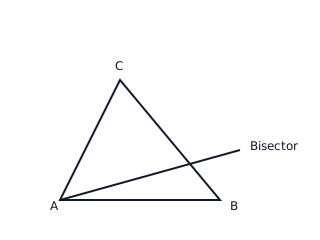
Solution:
- Draw line segment .
- Using a compass set to , draw an arc from .
- Using a compass set to , draw an arc from .
- Label the intersection and join and .
- To find points closer to than , construct the angle bisector of .
- The required region is the area inside on the side of the angle bisector.
Explanation:
The condition 'closer to than ' refers to the region bounded by the angle bisector of the angle formed by those two lines. Points on the bisector are equidistant from both lines.
Problem 4:
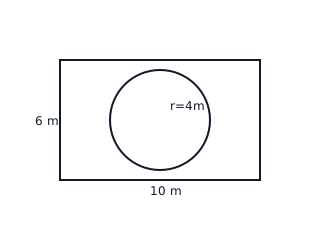
A rectangular garden measures by . A sprinkler is placed at the center of the garden and covers a circular area with a radius of . Draw the garden and the locus of the region that is NOT reached by the sprinkler.
Solution:
- Draw a rectangle by (using a scale of ).
- Mark the center by intersecting the diagonals.
- Draw a circle with radius from the center.
- The region outside this circle but inside the rectangle is the area not reached by the sprinkler.
Explanation:
The locus of points reached by the sprinkler is the area defined by . The region not reached is the complement of this set within the rectangle boundaries.