
Review the key concepts, formulae, and examples before starting your quiz.
🔑Concepts
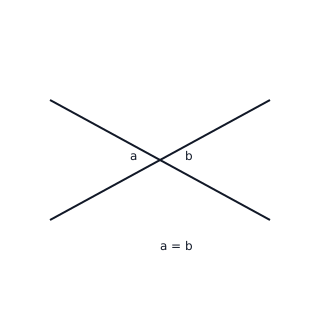
Vertical angles are the opposite angles formed by the intersection of two straight lines. They are always equal.
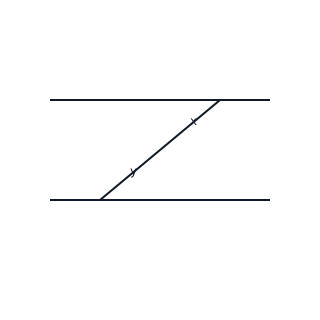
When a transversal intersects two parallel lines, alternate angles (forming a 'Z' shape) are equal.
Corresponding angles (forming an 'F' shape) are equal when a transversal cuts parallel lines.
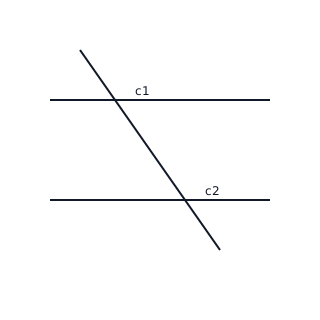
Co-interior angles (forming a 'C' or 'U' shape) between parallel lines are supplementary, meaning they sum to .
📐Formulae
💡Examples
Problem 1:
Find the value of if three angles on a straight line are , , and .
Solution:
Explanation:
Since the angles lie on a straight line, their sum must be equal to . We set up an algebraic equation and solve for .
Problem 2:
Calculate the size of each interior angle of a regular hexagon.
Solution:
A hexagon has sides.
Explanation:
First, find the total sum of interior angles using the formula . Then, divide by the number of sides () because it is a regular polygon.
Problem 3:
In a pair of parallel lines cut by a transversal, one of the co-interior angles is . Find the size of the other co-interior angle .
Solution:
Explanation:
Co-interior angles (also known as allied angles) between parallel lines are supplementary, meaning they add up to .
Problem 4:
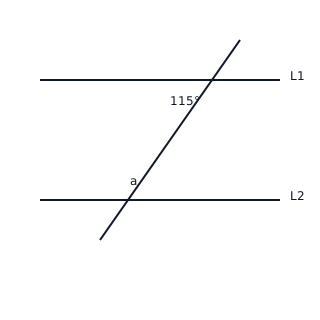
In the following diagram, lines and are parallel. Find the value of angle .
Solution:
Explanation:
The angles shown are co-interior angles between parallel lines. In geometry, co-interior angles sum to . Therefore, we subtract the known angle from to find the missing angle.
Problem 5:
Calculate the value of in the diagram where four angles meet at a central point.
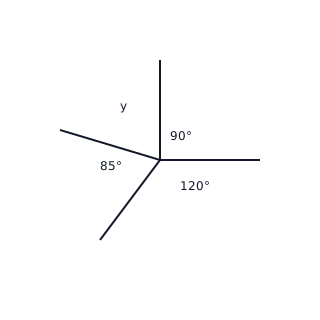
Solution:
Explanation:
Angles at a point must sum to exactly . By summing the three known angles and subtracting from , we determine the unknown angle .