
krit.club logo

Relations and Functions - Relations-advanced

Grade 9CBSE

Review the key concepts, formulae, and examples before starting your quiz.

🔑Concepts

•

The Cartesian Product of two sets AA and BB, denoted by A×BA \times B, is the set of all ordered pairs (a,b)(a, b) such that a∈Aa \in A and b∈Bb \in B. Visually, if A={x1,x2,x3}A = \{x_1, x_2, x_3\} and B={y1,y2}B = \{y_1, y_2\}, the product forms a grid of 6 points in a coordinate plane.
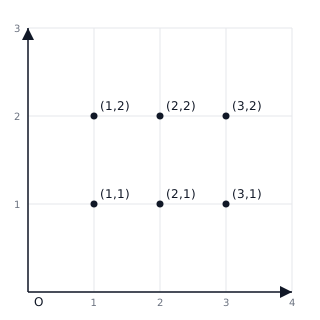
Grid representation of Cartesian Product A x B where A={1,2,3} and B={1,2}
•

A Relation RR from a set AA to set BB is a subset of the Cartesian product A×BA \times B. It is represented by an arrow diagram where arrows connect elements of AA to their images in BB. The set of all first elements in the pairs is the Domain, and the set of all second elements is the Range.
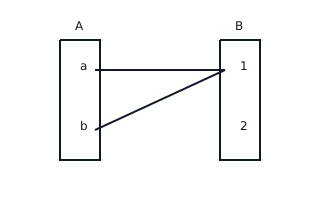
Arrow diagram showing a relation from set A to set B
•

Identity Relation: A relation IAI_A on set AA is called an identity relation if every element of AA is related to itself only, i.e., IA={(a,a):a∈A}I_A = \{(a, a) : a \in A\}. Graphically, this is represented by points lying on the line y=xy = x.

•

Universal Relation: A relation RR on set AA is universal if R=A×AR = A \times A, meaning every element of AA is related to every element of AA (including itself).

📐Formulae

A×B={(a,b):a∈A,b∈B}A \times B = \{(a, b) : a \in A, b \in B\}

n(A×B)=n(A)×n(B)n(A \times B) = n(A) \times n(B)

Total number of relations from A to B=2n(A)×n(B)Total\ number\ of\ relations\ from\ A\ to\ B = 2^{n(A) \times n(B)}

Domain(R)={x∈A:(x,y)∈R}Domain(R) = \{x \in A : (x, y) \in R\}

Range(R)={y∈B:(x,y)∈R}Range(R) = \{y \in B : (x, y) \in R\}

💡Examples

Problem 1:

If set A={1,2,3}A = \{1, 2, 3\} and set B={x,y}B = \{x, y\}, find the total number of relations possible from AA to BB.

Solution:

First, find the number of elements in sets AA and BB: n(A)=3n(A) = 3 n(B)=2n(B) = 2

Now, calculate the number of elements in the Cartesian product A×BA \times B: n(A×B)=n(A)×n(B)=3×2=6n(A \times B) = n(A) \times n(B) = 3 \times 2 = 6

The total number of relations from AA to BB is the number of subsets of A×BA \times B: Total relations=2n(A×B)=26=64Total\ relations = 2^{n(A \times B)} = 2^6 = 64

Explanation:

The number of relations is defined as 2mn2^{mn} where mm and nn are the number of elements in the two sets respectively.

Problem 2:

Let A={1,2,3,4,5,6}A = \{1, 2, 3, 4, 5, 6\}. Define a relation RR from AA to AA by R={(x,y):y=x+1,x,y∈A}R = \{(x, y) : y = x + 1, x, y \in A\}. Write down the domain and range.

Solution:

We check the condition y=x+1y = x + 1 for each x∈Ax \in A such that yy also belongs to AA: For x=1,y=1+1=2∈Ax = 1, y = 1 + 1 = 2 \in A For x=2,y=2+1=3∈Ax = 2, y = 2 + 1 = 3 \in A For x=3,y=3+1=4∈Ax = 3, y = 3 + 1 = 4 \in A For x=4,y=4+1=5∈Ax = 4, y = 4 + 1 = 5 \in A For x=5,y=5+1=6∈Ax = 5, y = 5 + 1 = 6 \in A For x=6,y=6+1=7∉Ax = 6, y = 6 + 1 = 7 \notin A

So, the relation in roster form is: R={(1,2),(2,3),(3,4),(4,5),(5,6)}R = \{(1, 2), (2, 3), (3, 4), (4, 5), (5, 6)\}

Domain = set of first elements = {1,2,3,4,5}\{1, 2, 3, 4, 5\} Range = set of second elements = {2,3,4,5,6}\{2, 3, 4, 5, 6\}

Explanation:

Since the relation is defined on set AA, both xx and yy must be elements of AA. When x=6x=6, y=7y=7 which is not in AA, so (6,7)(6,7) is excluded.

Problem 3:

Find the Cartesian product P×PP \times P if P={1,2}P = \{1, 2\}.

Solution:

Given P={1,2}P = \{1, 2\}, the Cartesian product P×PP \times P consists of all ordered pairs where both elements are from PP. P×P={(1,1),(1,2),(2,1),(2,2)}P \times P = \{(1, 1), (1, 2), (2, 1), (2, 2)\}

Explanation:

We pair every element of the first set with every element of the second set (in this case, the same set).

Problem 4:

Let A={1,2,3}A = \{1, 2, 3\}. Define a relation RR on AA by R={(x,y):y=x2,x,y∈A}R = \{(x, y) : y = x^2, x, y \in A\}. Represent this relation using a graph and state its Domain and Range.
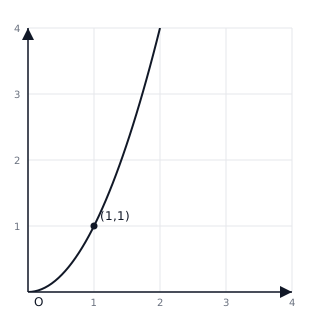
Graph of relation R showing the point (1,1) on the curve y=x^2

Solution:

Given A={1,2,3}A = \{1, 2, 3\} and y=x2y = x^2. If x=1,y=12=1∈Ax = 1, y = 1^2 = 1 \in A. So, (1,1)∈R(1, 1) \in R. If x=2,y=22=4∉Ax = 2, y = 2^2 = 4 \notin A. So, (2,4)∉R(2, 4) \notin R. If x=3,y=32=9∉Ax = 3, y = 3^2 = 9 \notin A. So, (3,9)∉R(3, 9) \notin R. Thus, R={(1,1)}R = \{(1, 1)\}. Domain of R={1}R = \{1\}. Range of R={1}R = \{1\}.

Explanation:

We check each element of AA as xx and see if x2x^2 also belongs to AA. Only (1,1)(1, 1) satisfies the condition x,y∈Ax, y \in A.

Problem 5:

Determine the relation R={(x,y):x+2y=8}R = \{(x, y) : x + 2y = 8\} where x,y∈{1,2,3,4,5,6}x, y \in \{1, 2, 3, 4, 5, 6\}. Express RR as a set of ordered pairs and visualize it on a coordinate plane.
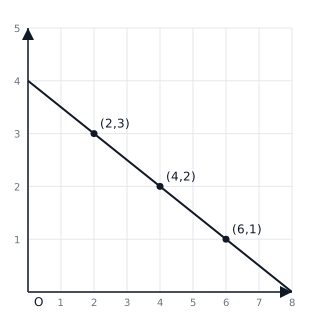
Plot of ordered pairs (2,3), (4,2), and (6,1) on the line x + 2y = 8

Solution:

x+2y=8  ⟹  2y=8−x  ⟹  y=8−x2x + 2y = 8 \implies 2y = 8 - x \implies y = \frac{8 - x}{2}. We test values of x∈{1,2,3,4,5,6}x \in \{1, 2, 3, 4, 5, 6\}: If x=2,y=8−22=3∈A  ⟹  (2,3)∈Rx=2, y=\frac{8-2}{2}=3 \in A \implies (2,3) \in R. If x=4,y=8−42=2∈A  ⟹  (4,2)∈Rx=4, y=\frac{8-4}{2}=2 \in A \implies (4,2) \in R. If x=6,y=8−62=1∈A  ⟹  (6,1)∈Rx=6, y=\frac{8-6}{2}=1 \in A \implies (6,1) \in R. R={(2,3),(4,2),(6,1)}R = \{(2, 3), (4, 2), (6, 1)\}.

Explanation:

We solve the equation for yy and substitute elements of the set to find which pairs result in integer values that also belong to the set.