krit.club logo

Relations and Functions - Cartesian Product of Sets-advanced

Grade 9CBSE

Review the key concepts, formulae, and examples before starting your quiz.

🔑Concepts

•

The Cartesian Product of two sets AA and BB, denoted by A×BA \times B, is the set of all possible ordered pairs (a,b)(a, b) where a∈Aa \in A and b∈Bb \in B. It can be visualized as a grid of points on a coordinate plane if the sets are numerical.
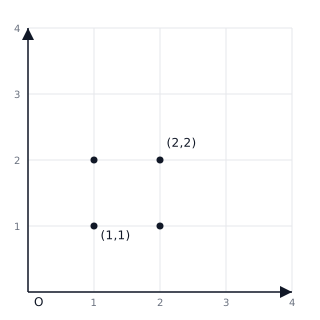
A coordinate grid showing points representing the Cartesian product of {1, 2} and {1, 2}.
•

Equality of Ordered Pairs: Two ordered pairs (a,b)(a, b) and (c,d)(c, d) are equal if and only if their corresponding first elements are equal (a=ca = c) and their corresponding second elements are equal (b=db = d).

Flowchart showing conditions for equality of ordered pairs.
•

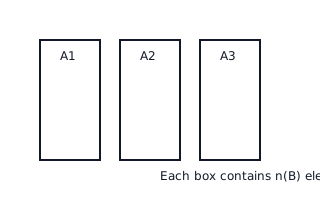
Cardinality Rule: The number of elements in A×BA \times B is the product of the number of elements in set AA and set BB, i.e., n(A×B)=n(A)×n(B)n(A \times B) = n(A) \times n(B).

Visual representation showing n(A) groups each containing n(B) elements.
•

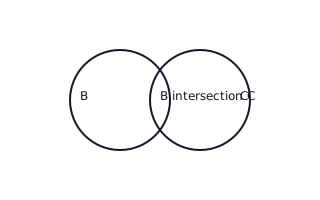
Distributive Property: The Cartesian product distributes over union, intersection, and set difference. For example, A×(B∩C)=(A×B)∩(A×C)A \times (B \cap C) = (A \times B) \cap (A \times C).

Venn diagram showing intersection of sets B and C used in distributive laws.

📐Formulae

A×B={(a,b):a∈A,b∈B}A \times B = \{ (a, b) : a \in A, b \in B \}

(a,b)=(c,d)  ⟺  a=c and b=d(a, b) = (c, d) \iff a = c \text{ and } b = d

n(A×B)=n(A)⋅n(B)n(A \times B) = n(A) \cdot n(B)

A×(B∪C)=(A×B)∪(A×C)A \times (B \cup C) = (A \times B) \cup (A \times C)

A×(B∩C)=(A×B)∩(A×C)A \times (B \cap C) = (A \times B) \cap (A \times C)

A×(B−C)=(A×B)−(A×C)A \times (B - C) = (A \times B) - (A \times C)

💡Examples

Problem 1:

Find the values of xx and yy if (x3+1,y−23)=(53,13)(\frac{x}{3} + 1, y - \frac{2}{3}) = (\frac{5}{3}, \frac{1}{3}).

Solution:

By the definition of equality of ordered pairs, we equate the corresponding components:

  1. x3+1=53\frac{x}{3} + 1 = \frac{5}{3} Subtracting 11 from both sides: x3=53−1\frac{x}{3} = \frac{5}{3} - 1 x3=23\frac{x}{3} = \frac{2}{3} x=2x = 2

  2. y−23=13y - \frac{2}{3} = \frac{1}{3} Adding 23\frac{2}{3} to both sides: y=13+23y = \frac{1}{3} + \frac{2}{3} y=33y = \frac{3}{3} y=1y = 1

Therefore, x=2x = 2 and y=1y = 1.

Explanation:

Two ordered pairs are equal if their first elements are equal and their second elements are equal. We solve the resulting linear equations for the variables.

Problem 2:

If A={1,2}A = \{1, 2\} and B={3,4}B = \{3, 4\}, find A×BA \times B and show that A×B≠B×AA \times B \neq B \times A.

Solution:

A×B={(1,3),(1,4),(2,3),(2,4)}A \times B = \{ (1, 3), (1, 4), (2, 3), (2, 4) \} Now, find B×AB \times A: B×A={(3,1),(3,2),(4,1),(4,2)}B \times A = \{ (3, 1), (3, 2), (4, 1), (4, 2) \} Comparing the sets, we see that (1,3)∈A×B(1, 3) \in A \times B but (1,3)∉B×A(1, 3) \notin B \times A. Since the ordered pairs are different, A×B≠B×AA \times B \neq B \times A.

Explanation:

The order of elements in an ordered pair matters. (1,3)(1, 3) is not the same as (3,1)(3, 1).

Problem 3:

The Cartesian product A×AA \times A has 99 elements, among which are found (−1,0)(-1, 0) and (0,1)(0, 1). Find the set AA and the remaining elements of A×AA \times A.

Solution:

We know n(A×A)=n(A)⋅n(A)=9n(A \times A) = n(A) \cdot n(A) = 9. This implies n(A)=9=3n(A) = \sqrt{9} = 3. From the given elements (−1,0)(-1, 0) and (0,1)(0, 1), the components belong to set AA. Therefore, the elements of AA are {−1,0,1}\{-1, 0, 1\}. A={−1,0,1}A = \{-1, 0, 1\} Now, A×A={(−1,−1),(−1,0),(−1,1),(0,−1),(0,0),(0,1),(1,−1),(1,0),(1,1)}A \times A = \{(-1, -1), (-1, 0), (-1, 1), (0, -1), (0, 0), (0, 1), (1, -1), (1, 0), (1, 1)\}. The remaining elements are: {(−1,−1),(−1,1),(0,−1),(0,0),(1,−1),(1,0),(1,1)}\{(-1, -1), (-1, 1), (0, -1), (0, 0), (1, -1), (1, 0), (1, 1)\}.

Explanation:

Since the product is A×AA \times A, both elements of any ordered pair must belong to set AA. By identifying all unique first and second components from the given pairs, we reconstruct set AA.

Problem 4:

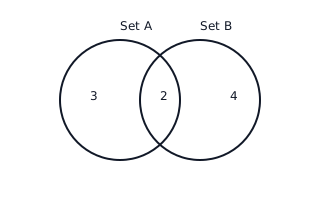
Given A={x:x2−5x+6=0}A = \{x : x^2 - 5x + 6 = 0\} and B={2,4}B = \{2, 4\}, find (A−B)×(B−A)(A - B) \times (B - A).

Venn diagram showing Set A = {2, 3} and Set B = {2, 4} with 2 in the intersection.

Solution:

  1. Solve for AA: x2−5x+6=0  ⟹  (x−2)(x−3)=0  ⟹  A={2,3}x^2 - 5x + 6 = 0 \implies (x-2)(x-3) = 0 \implies A = \{2, 3\}.
  2. Given B={2,4}B = \{2, 4\}.
  3. Calculate A−BA - B: Elements in AA not in BB. A−B={3}A - B = \{3\}.
  4. Calculate B−AB - A: Elements in BB not in AA. B−A={4}B - A = \{4\}.
  5. Find the product: {3}×{4}={(3,4)}\{3\} \times \{4\} = \{(3, 4)\}.

Explanation:

First, the sets are defined by solving the quadratic equation. Then, set difference is applied to find unique elements. Finally, the Cartesian product of the resulting single-element sets yields one ordered pair.

Problem 5:

If A×B={(a,1),(b,3),(a,3),(b,1),(a,2),(b,2)}A \times B = \{(a, 1), (b, 3), (a, 3), (b, 1), (a, 2), (b, 2)\}, find the sets AA and BB. Represent this mapping using an arrow diagram.
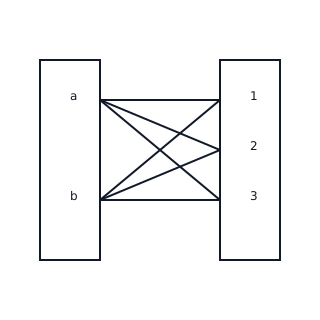
Arrow diagram mapping elements {a, b} to {1, 2, 3}.

Solution:

  1. Set AA is the set of all first elements in the ordered pairs: A={a,b,a,b,a,b}={a,b}A = \{a, b, a, b, a, b\} = \{a, b\}.
  2. Set BB is the set of all second elements in the ordered pairs: $B = {1, 3, 3, 1, 2, 2} = {1, 2, 3}.
  3. n(A)=2n(A) = 2, n(B)=3n(B) = 3. Total elements = 2×3=62 \times 3 = 6.

Explanation:

By definition of the Cartesian product, the domain (Set A) consists of all first components and the codomain (Set B) consists of all second components of the pairs.