
Review the key concepts, formulae, and examples before starting your quiz.
🔑Concepts
An ordered pair consists of two objects or elements in a fixed order, written as . Two ordered pairs and are equal if and only if their corresponding elements are equal: and . This is the foundation for plotting points on a Cartesian plane.
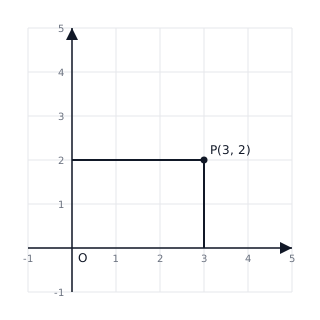
The Cartesian Product of two non-empty sets and is the set of all ordered pairs such that and . Visually, if and , the product represents all possible connections from to .

A Relation from set to set is a subset of the Cartesian product . The set of all first elements of the ordered pairs in is the Domain, and the set of all second elements is the Range. The entire set is called the Codomain.
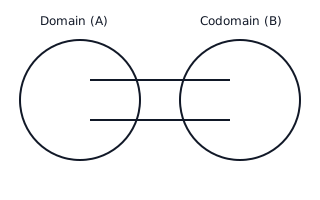
A Function from to is a special type of relation where every element in set is associated with exactly one element in set . We write , where is the image of and is the pre-image of .
📐Formulae
(where represents the number of elements in the set)
💡Examples
Problem 1:
Find the values of and if .
Solution:
Given . By the equality of ordered pairs:
Also, So, .
Explanation:
We use the property that two ordered pairs are equal if and only if their corresponding components are equal. This results in two independent linear equations.
Problem 2:
Let . Define a relation from to by . Write down the domain and range.
Solution:
Given and where . When When When When When When (but , so we exclude this pair). Domain Range
Explanation:
To find the domain and range, we first list the elements of the relation by applying the condition . The domain is the set of all values that have a corresponding in .
Problem 3:
If and , find the number of elements in and the total number of possible relations.
Solution:
Given . Set , so . Number of elements in . Number of relations .
Explanation:
The number of elements in the Cartesian product is the product of the number of elements in each set. The number of relations is raised to the power of the number of elements in the Cartesian product because every subset of is a relation.
Problem 4:
Given the set , define a relation on by . List the elements of and represent it as a mapping diagram.

Solution:
- Find pairs where and .
- For . (Valid: )
- For . (Valid: )
- For . (Invalid: )
- For . (Invalid: ) So, .
Explanation:
In a relation defined on set , both the first and second elements must belong to . Since and are not in the set , those inputs do not have related outputs within this set.
Problem 5:
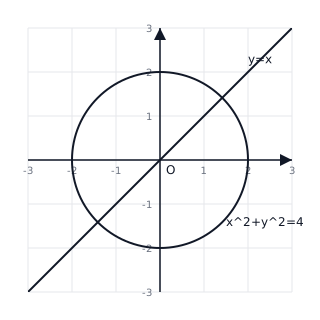
Identify which of the following relations represent a function by analyzing their graphs: and .
Solution:
- is a linear equation . For every , there is exactly one . This is a function.
- is a circle . For a single value of (like ), there are two values of ( and ). This fails the vertical line test and is not a function.
Explanation:
A relation is a function if any vertical line drawn through the graph intersects it at most once. The circle fails this because a vertical line through the center hits the top and bottom of the circle.