
Review the key concepts, formulae, and examples before starting your quiz.
🔑Concepts
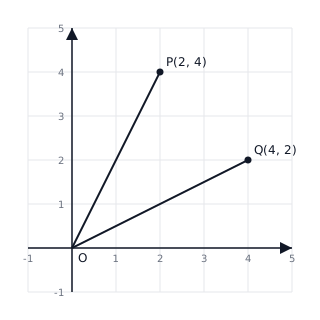
An ordered pair consists of two elements grouped in a specific order, denoted as , where is the first element and is the second. Crucially, unless . This property allows us to represent positions uniquely on a Cartesian plane.
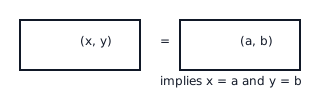
Two ordered pairs and are equal if and only if their corresponding components are equal, i.e., and . This equality is the basis for solving algebraic equations involving coordinate geometry.
The Cartesian Product is the set of all possible ordered pairs where and . If and , then the total number of ordered pairs is .

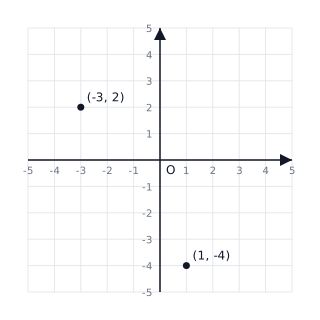
Ordered pairs can be visualized as points in the 2D plane. The first component corresponds to the horizontal displacement (abscissa), and the second component corresponds to the vertical displacement (ordinate).
📐Formulae
💡Examples
Problem 1:
Find the values of and if .
Solution:
Given the equality of ordered pairs:
By equating the first components:
By equating the second components:
Therefore, and .
Explanation:
To find the variables, we use the definition that two ordered pairs are equal if their corresponding coordinates are equal.
Problem 2:
If , determine the values of and .
Solution:
Equating the first elements:
Equating the second elements:
Final values: .
Explanation:
This involves solving simple linear equations derived from the property of equality of ordered pairs.
Problem 3:
If and , find and show that .
Solution:
Set has elements. Set has elements.
The Cartesian product is:
Counting the elements in , we get . Calculating :
Hence, .
Explanation:
The Cartesian product forms all possible pairs by taking the first element from set A and the second from set B.
Problem 4:
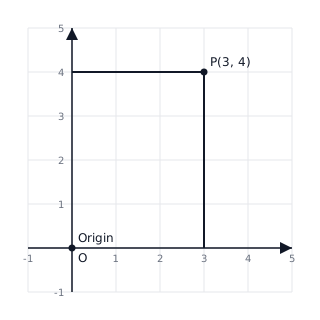
Determine the values of and such that the ordered pair lies at the origin . Visualize the position of the point if and .
Solution:
Given . By the equality of ordered pairs:
- For the second part, if and : The point is .
Explanation:
To find the variables, we equate the corresponding elements of the ordered pairs. A point at the origin must have both its and coordinates equal to zero.
Problem 5:
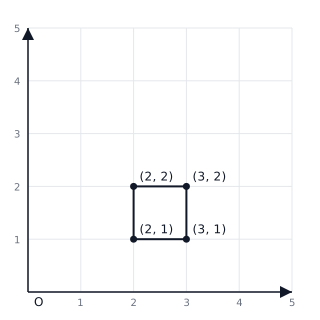
Given the set and , find the Cartesian product and represent it on a coordinate plane.
Solution:
First, solve for elements of : . So, . . .
Explanation:
We first identify the elements of set A by solving the quadratic equation. Then, we pair every element of A with every element of B to form the Cartesian product set.