
Review the key concepts, formulae, and examples before starting your quiz.
🔑Concepts
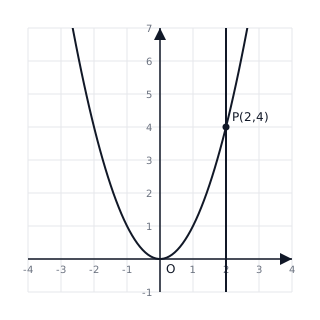
A function is a special relation where every element is associated with exactly one element . Graphically, this is verified using the Vertical Line Test: if any vertical line intersects the graph more than once, the graph does not represent a function.
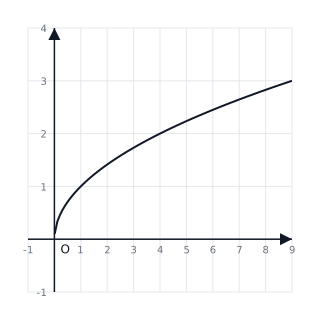
The Domain of a function is the set of all possible input values () for which the function is defined. The Range is the set of all actual output values (). For a square root function like , the domain is .
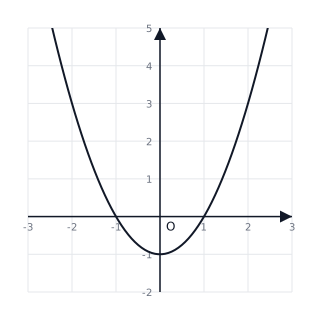
A Polynomial Function of degree 2 is called a Quadratic Function, expressed as . Its graph is a parabola. If , the parabola opens upwards.
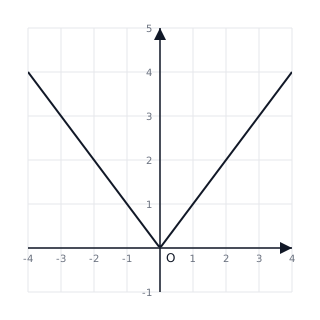
The Modulus Function (Absolute Value Function) is defined as , which returns if and if . The graph forms a 'V' shape with the vertex at the origin.
📐Formulae
💡Examples
Problem 1:
If , calculate the value of .
Solution:
First, find :
Next, find :
Now, add the results:
Explanation:
We evaluate the function by substituting the specific values of into the polynomial expression and then perform the required addition.
Problem 2:
Given , find the expression for .
Solution:
Let . This implies that . Substitute into the expression for : Expand the terms: Combine like terms: Replacing back with :
Explanation:
To find when is given, use a substitution variable to solve for the original variable in terms of the new one.
Problem 3:
Determine if the relation is a function.
Solution:
Check the inputs (first elements of the ordered pairs): The inputs are and . The input is associated with two different outputs: and .
Explanation:
By definition, for a relation to be a function, each input in the domain must have exactly one unique output. Since the input has two outputs, is not a function.
Problem 4:
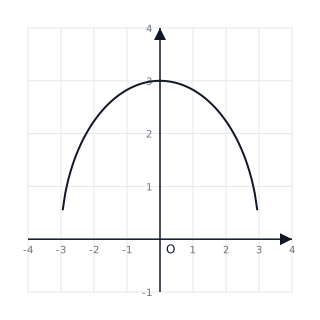
Identify the domain and range of the function and visualize its graph.
Solution:
For the square root to be defined, . This implies , so the Domain is . Since , the maximum value of is and the minimum is . Thus, the Range is .
Explanation:
The expression represents a semi-circle with radius 3 centered at the origin, lying above the x-axis.
Problem 5:
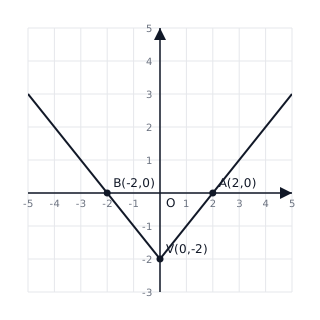
Determine the domain and range of the function . Sketch the graph and find the value of for which .
Solution:
- For the domain, since is defined for all real numbers, the domain is .
- For the range, we know for all . Therefore, . The range is .
- To find when , we set . This gives or .
Explanation:
The modulus function creates a V-shape with its vertex at the origin. Subtracting 2 from the function value shifts the entire graph downward by 2 units on the y-axis, making the new vertex .