
Review the key concepts, formulae, and examples before starting your quiz.
🔑Concepts
A quadrilateral is a closed figure with four sides, four vertices, and four angles. It is formed by joining four points in an order such that no three points are collinear.
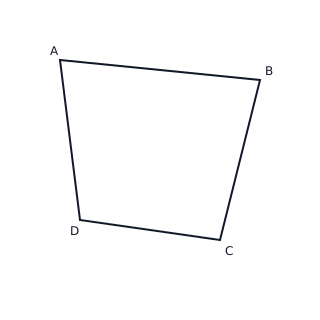
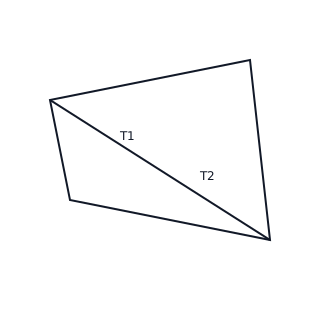
The sum of the interior angles of a quadrilateral is always . This is known as the Angle Sum Property of a quadrilateral. It can be verified by dividing the quadrilateral into two triangles using a diagonal; since each triangle's angle sum is , the total sum is .
Consecutive sides are sides that share a common vertex (e.g., and ). Opposite sides are sides that do not share a vertex (e.g., and ). Similarly, opposite angles are those not sharing a common side (e.g., and ).
A convex quadrilateral has all its interior angles less than and both its diagonals lie entirely inside the figure. In a concave (re-entrant) quadrilateral, at least one interior angle is reflex () and one diagonal lies outside.
📐Formulae
💡Examples
Problem 1:
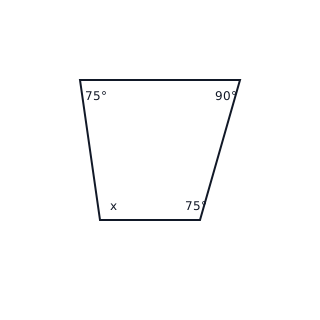
The three angles of a quadrilateral are , , and . Find the measure of the fourth angle.
Solution:
Let the fourth angle be . According to the angle sum property of a quadrilateral: The fourth angle is .
Explanation:
We use the fundamental property that all four internal angles of any quadrilateral must sum up to exactly . By subtracting the sum of the known angles from , we find the unknown angle.
Problem 2:
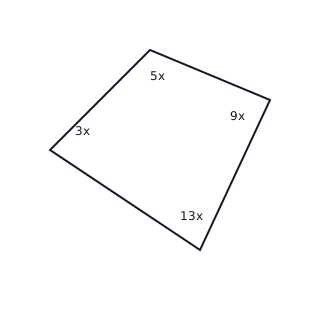
The angles of a quadrilateral are in the ratio . Find all the angles of the quadrilateral.
Solution:
Let the angles be . By Angle Sum Property: Now find the individual angles:
Explanation:
When angles are given in ratio, we represent them as multiples of a common variable . Using the angle sum property (), we solve for and kemudian multiply by each ratio part to get the actual angles.