krit.club logo

Quadrilaterals - Parallelograms

Grade 9CBSE

Review the key concepts, formulae, and examples before starting your quiz.

🔑Concepts

•

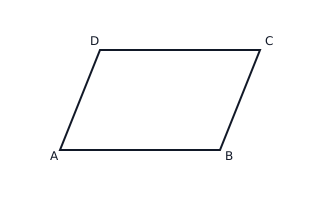
A quadrilateral is a parallelogram if its opposite sides are parallel. In parallelogram ABCDABCD, AB∥CDAB \parallel CD and BC∥ADBC \parallel AD.

Parallelogram ABCD showing opposite sides parallel.
•

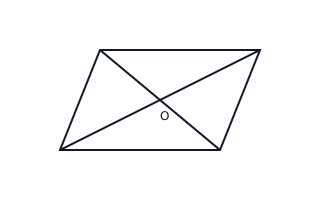
Properties of a parallelogram: (i) Opposite sides are equal (AB=CDAB = CD, BC=ADBC = AD). (ii) Opposite angles are equal (∠A=∠C\angle A = \angle C, ∠B=∠D\angle B = \angle D). (iii) Diagonals bisect each other (AO=OCAO = OC, BO=ODBO = OD).

Parallelogram with diagonals bisecting at O.
•

The sum of any two adjacent angles of a parallelogram is 180∘180^{\circ} (Supplementary angles). For example, ∠A+∠B=180∘\angle A + \angle B = 180^{\circ}.

•

A diagonal of a parallelogram divides it into two congruent triangles. △ABC≅△CDA\triangle ABC \cong \triangle CDA.

📐Formulae

Area of Parallelogram=base×height\text{Area of Parallelogram} = \text{base} \times \text{height}

Perimeter=2(a+b)\text{Perimeter} = 2(a + b) (where aa and bb are adjacent sides)

∠A+∠B=180∘\angle A + \angle B = 180^{\circ}

∠A=∠C,∠B=∠D\angle A = \angle C, \angle B = \angle D

💡Examples

Problem 1:

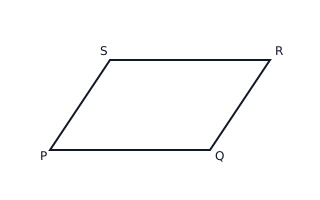
In a parallelogram PQRSPQRS, if ∠P=(2x+10)∘\angle P = (2x + 10)^{\circ} and ∠Q=(3x+20)∘\angle Q = (3x + 20)^{\circ}, find the value of xx and the measures of all angles.

Parallelogram PQRS

Solution:

In a parallelogram, adjacent angles are supplementary. ∠P+∠Q=180∘\angle P + \angle Q = 180^{\circ} (2x+10)+(3x+20)=180(2x + 10) + (3x + 20) = 180 5x+30=1805x + 30 = 180 5x=1505x = 150 x=30x = 30 Now, calculate angles: ∠P=2(30)+10=70∘\angle P = 2(30) + 10 = 70^{\circ} ∠Q=3(30)+20=110∘\angle Q = 3(30) + 20 = 110^{\circ} Since opposite angles are equal: ∠R=∠P=70∘\angle R = \angle P = 70^{\circ} ∠S=∠Q=110∘\angle S = \angle Q = 110^{\circ}

Explanation:

Adjacent angles in a parallelogram add up to 180∘180^{\circ} because they are consecutive interior angles between parallel lines.

Problem 2:

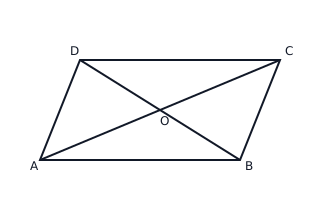
In parallelogram ABCDABCD, diagonals ACAC and BDBD intersect at OO. If AO=3 cmAO = 3 \text{ cm} and OD=4 cmOD = 4 \text{ cm}, find the lengths of ACAC and BDBD.

Parallelogram with diagonals intersecting at O

Solution:

The diagonals of a parallelogram bisect each other. Therefore: AC=2×AOAC = 2 \times AO AC=2×3=6 cmAC = 2 \times 3 = 6 \text{ cm} Similarly, BD=2×ODBD = 2 \times OD BD=2×4=8 cmBD = 2 \times 4 = 8 \text{ cm}

Explanation:

Bisection means the intersection point OO is the midpoint of both diagonals.