
Review the key concepts, formulae, and examples before starting your quiz.
🔑Concepts
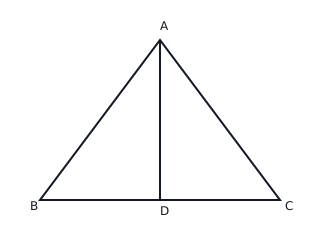
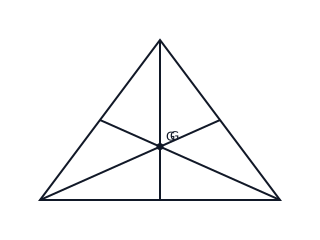
A median of a triangle is a line segment joining a vertex to the midpoint of the opposite side. Every triangle has exactly three medians, which are concurrent (they meet at a single point).
The point of concurrency of the three medians is called the Centroid (often denoted as ). A key property of the centroid is that it divides each median in the ratio , with the longer segment being the one adjacent to the vertex.
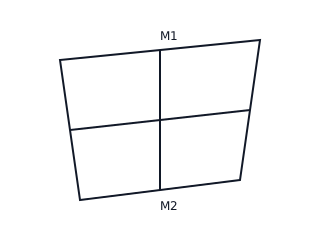
In any quadrilateral, the segments joining the midpoints of opposite sides and the segment joining the midpoints of the diagonals all bisect each other at a single point. This point is the centroid of the quadrilateral's vertices.
📐Formulae
💡Examples
Problem 1:
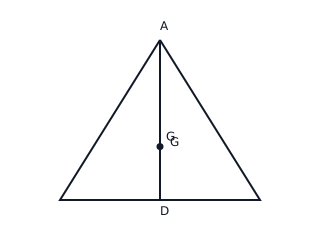
In , is a median and is the centroid. If the length of , find the lengths of and .
Solution:
- According to the Centroid Theorem, the centroid divides the median in the ratio .
- This means and .
- Calculate :
- Calculate : Final Answer: and .
Explanation:
The theorem states that the distance from the vertex to the centroid is twice the distance from the centroid to the midpoint of the opposite side.
Problem 2:
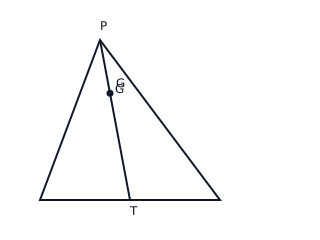
In , is a median. If where is the centroid, find the length of the segment and the total length of the median .
Solution:
- We know from the property of medians that .
- Given , we can find :
- The total length of the median is the sum of and : Final Answer: and .
Explanation:
By applying the ratio , if the smaller part of the median (from centroid to side) is known, the larger part is double that value.