
Review the key concepts, formulae, and examples before starting your quiz.
🔑Concepts
The Midpoint Theorem states that the line segment joining the midpoints of two sides of a triangle is parallel to the third side and is equal to half of it.
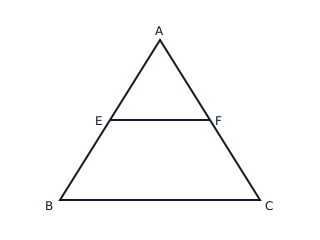
The Converse of the Midpoint Theorem: The line drawn through the midpoint of one side of a triangle, parallel to another side, bisects the third side.
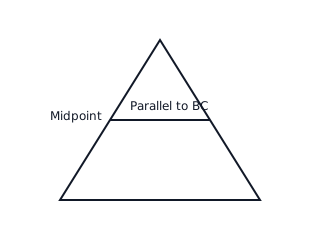
In , if and are midpoints of and , then and .
A quadrilateral formed by joining the midpoints of the sides of any quadrilateral is always a parallelogram.
📐Formulae
💡Examples
Problem 1:
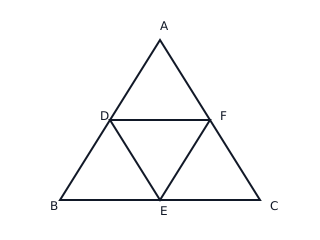
In , , , and are the midpoints of sides , , and respectively. If cm, cm, and cm, find the perimeter of .
Solution:
By the Midpoint Theorem, the segment joining the midpoints of two sides is half the third side. cm cm cm Perimeter of cm.
Explanation:
We apply the Midpoint Theorem three times to find the lengths of the sides of the inner triangle formed by the midpoints.
Problem 2:
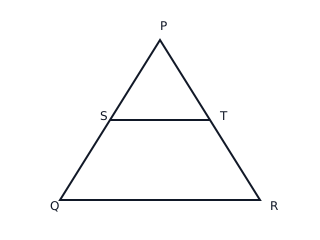
In , is the midpoint of . A line through is drawn parallel to to intersect at . If cm, find .
Solution:
In , is the midpoint of and . According to the Converse of Midpoint Theorem, a line drawn through the midpoint of one side of a triangle parallel to another side bisects the third side. Therefore, is the midpoint of . cm.
Explanation:
This problem uses the Converse of the Midpoint Theorem to prove that is a midpoint, thus calculating the segment length as half of the total side.