
Review the key concepts, formulae, and examples before starting your quiz.
🔑Concepts
Tessellation or tiling of a plane is the process of covering a surface with a repeating pattern of shapes with no overlaps and no gaps. A fundamental property of geometry is that any quadrilateral (convex or concave) can tile the plane because the sum of the interior angles of a quadrilateral is .
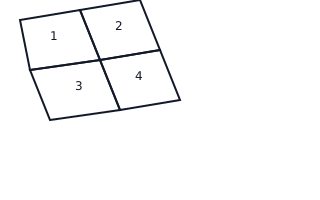
To create a tiling with an arbitrary quadrilateral, you rotate the shape around the midpoint of each side. This ensures that at every vertex where the shapes meet, one of each of the four interior angles () is present.
The tiling property relies on the Angle Sum Property of a Quadrilateral. Since , arranging these four angles around a single point creates a full circle, allowing the plane to be perfectly filled.
Even non-convex (concave) quadrilaterals can tile the plane. The logic remains the same: four such shapes can be oriented so that their four distinct angles meet at a common vertex point to form .
📐Formulae
💡Examples
Problem 1:
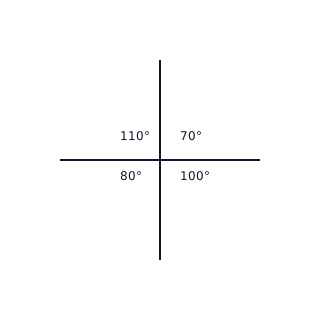
Show that four identical quadrilaterals with angles , , , and can meet at a single point to form a tiling. Draw the vertex point and the meeting angles.
Solution:
- Verify the sum: .
- Since the sum is exactly , the four different angles can be arranged around a single vertex point such that no gaps exist.
- By repeating this arrangement and rotating the quadrilateral about side midpoints, the entire plane is covered.
Explanation:
Because the interior angles sum to a full circle, placing one of each angle at a junction point creates a perfect fit.
Problem 2:
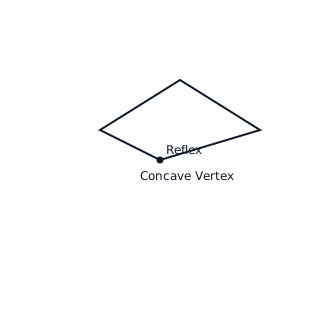
Given a concave quadrilateral with interior angles , , , and a reflex angle of , explain how it tiles the plane despite its shape.
Solution:
- Sum of interior angles: .
- Even though it is concave, the angle sum remains .
- In a tiling, the reflex angle is 'filled' by the other three angles () from adjacent quadrilaterals at various vertices.
Explanation:
Tessellation works for all quadrilaterals because the topological property of having four angles that sum to is universal for 4-gons.