krit.club logo

Quadrilaterals - Midpoint Theorem for Quadrilaterals: Varignon's Theorem

Grade 9CBSE

Review the key concepts, formulae, and examples before starting your quiz.

🔑Concepts

•

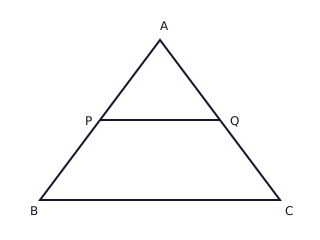
The Midpoint Theorem states that the line segment joining the midpoints of any two sides of a triangle is parallel to the third side and equal to half of it. In △ABC\triangle ABC, if PP and QQ are midpoints of ABAB and ACAC, then PQ∥BCPQ \parallel BC and PQ=12BCPQ = \frac{1}{2}BC.

Triangle ABC with midpoints P and Q of sides AB and AC joined by segment PQ.
•

Varignon's Theorem states that the quadrilateral formed by joining the midpoints of the sides of any quadrilateral is a parallelogram.
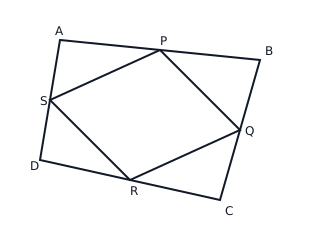
Quadrilateral ABCD with midpoints P, Q, R, S forming an inner parallelogram PQRS.
•

The perimeter of the Varignon parallelogram is equal to the sum of the diagonals of the original quadrilateral. Specifically, PQ+QR+RS+SP=AC+BDPQ + QR + RS + SP = AC + BD.

•

The area of the Varignon parallelogram is exactly half of the area of the original quadrilateral. Area of PQRS=12×Area of ABCDPQRS = \frac{1}{2} \times \text{Area of } ABCD.

📐Formulae

PQ∥AC and PQ=12ACPQ \parallel AC \text{ and } PQ = \frac{1}{2}AC

Perimeter of PQRS=AC+BD\text{Perimeter of } PQRS = AC + BD

Area(PQRS)=12Area(ABCD)\text{Area}(PQRS) = \frac{1}{2} \text{Area}(ABCD)

💡Examples

Problem 1:

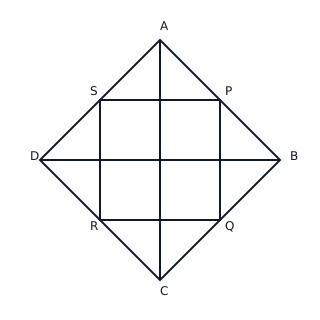
In a quadrilateral ABCDABCD, the diagonals ACAC and BDBD are perpendicular. P,Q,RP, Q, R and SS are the midpoints of sides AB,BC,CDAB, BC, CD and DADA respectively. Prove that PQRSPQRS is a rectangle.

Rhombus ABCD with perpendicular diagonals and rectangular midpoint quadrilateral PQRS.

Solution:

  1. In △ABC\triangle ABC, PP and QQ are midpoints. By Midpoint Theorem, PQ∥ACPQ \parallel AC and PQ=12ACPQ = \frac{1}{2}AC.
  2. Similarly, in △ADC\triangle ADC, SR∥ACSR \parallel AC and SR=12ACSR = \frac{1}{2}AC. Thus PQ∥SRPQ \parallel SR and PQ=SRPQ = SR.
  3. This makes PQRSPQRS a parallelogram.
  4. Now, PQ∥ACPQ \parallel AC and QR∥BDQR \parallel BD (by Midpoint Theorem in △BCD\triangle BCD).
  5. Since AC⊥BDAC \perp BD, the lines parallel to them must also be perpendicular. Therefore, PQ⊥QRPQ \perp QR.
  6. A parallelogram with one right angle is a rectangle. Hence, PQRSPQRS is a rectangle.

Explanation:

We use the Midpoint Theorem to show the inner shape is a parallelogram first, then use the property of the diagonals being perpendicular to show the adjacent sides of the inner shape are perpendicular.

Problem 2:

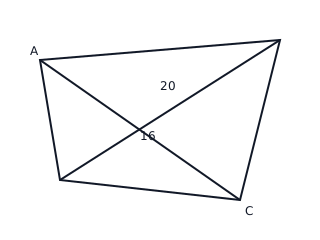
In a quadrilateral ABCDABCD, P,Q,R,SP, Q, R, S are the midpoints of AB,BC,CD,DAAB, BC, CD, DA. If AC=16 cmAC = 16\text{ cm} and BD=20 cmBD = 20\text{ cm}, find the perimeter of the quadrilateral PQRSPQRS.

Quadrilateral with diagonals labeled 16 and 20.

Solution:

  1. In △ABC\triangle ABC, PQPQ is the line joining midpoints of ABAB and BCBC. By Midpoint Theorem: PQ=12AC=12×16=8 cmPQ = \frac{1}{2}AC = \frac{1}{2} \times 16 = 8\text{ cm}
  2. In △ADC\triangle ADC, SRSR is the line joining midpoints of ADAD and CDCD. By Midpoint Theorem: SR=12AC=12×16=8 cmSR = \frac{1}{2}AC = \frac{1}{2} \times 16 = 8\text{ cm}
  3. In △BCD\triangle BCD, QR=12BD=12×20=10 cmQR = \frac{1}{2}BD = \frac{1}{2} \times 20 = 10\text{ cm}.
  4. In △ABD\triangle ABD, PS=12BD=12×20=10 cmPS = \frac{1}{2}BD = \frac{1}{2} \times 20 = 10\text{ cm}.
  5. Perimeter of PQRS=PQ+QR+RS+SP=8+10+8+10=36 cmPQRS = PQ + QR + RS + SP = 8 + 10 + 8 + 10 = 36\text{ cm}.

Explanation:

The perimeter of the midpoint quadrilateral is the sum of the diagonals of the outer quadrilateral.

Midpoint Theorem for Quadrilaterals: Varignon's Theorem Class 9 Notes & Examples