
Review the key concepts, formulae, and examples before starting your quiz.
🔑Concepts
The Baudhayana-Pythagoras Theorem states that in a right-angled triangle, the square of the hypotenuse is equal to the sum of the squares of the other two sides. Ancient Indian mathematician Baudhayana described this property long before Pythagoras.
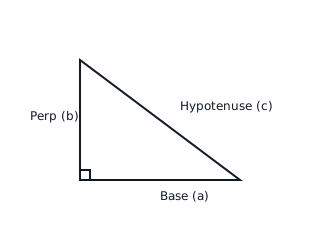
A Pythagorean Triplet consists of three positive integers such that . For any natural number , a general form for these triplets is . Note that is always the largest side (the hypotenuse).
Integer Sidelengths: While many right triangles have sides with square roots (irrational numbers), the Baudhayana-Pythagoras theorem is most commonly applied in Grade 8 to triangles where all three side lengths are whole numbers (integers), such as or .
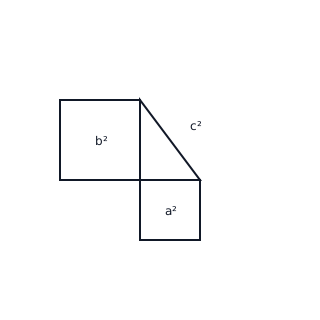
Visualizing Squares: The theorem can be seen as the relationship between the areas of squares built on each side of the triangle. The area of the square on the hypotenuse equals the sum of the areas of the squares on the other two sides.
📐Formulae
💡Examples
Problem 1:
Check if is a Pythagorean triplet.
Solution:
Identify the sides: . Calculate : . Calculate : . Since , the numbers form a Pythagorean triplet.
Explanation:
We square the two smaller numbers, find their sum using vertical addition, and verify if it equals the square of the largest number.
Problem 2:
Write a Pythagorean triplet whose smallest member is .
Solution:
We use the general form . Let . Now find the other two members: . . The triplet is . Check: .
Explanation:
By setting the given even number to , we find the value of and then use it to calculate the remaining two integers of the triplet.
Problem 3:
In a right triangle, the two sides containing the right angle are and . Find the hypotenuse.
Solution:
Let and . We need to find . . . The hypotenuse is .
Explanation:
According to the Baudhayana-Pythagoras theorem, we sum the squares of the base and perpendicular to find the square of the hypotenuse.
Problem 4:
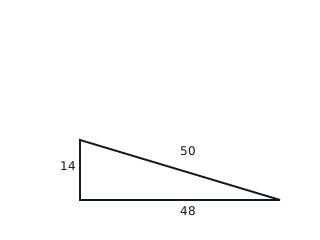
Find a Pythagorean triplet whose one member is .
Solution:
Let . Then . The other two members are: So, the triplet is . Verification: .
Explanation:
We use the general form . Since is even, we set to find .
Problem 5:
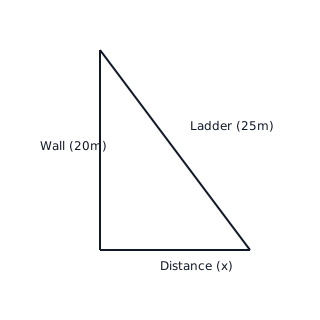
A ladder long reaches a window of a building above the ground. Determine the distance of the foot of the ladder from the building.
Solution:
Let the distance be . By the Baudhayana-Pythagoras theorem: Therefore, the distance is .
Explanation:
The ladder, the wall, and the ground form a right-angled triangle where the ladder is the hypotenuse.