
Review the key concepts, formulae, and examples before starting your quiz.
🔑Concepts
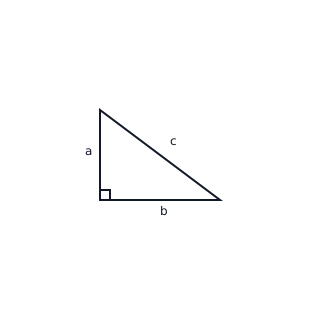
The Baudhayana-Pythagoras theorem states that in a right-angled triangle, the square of the hypotenuse is equal to the sum of the squares of the other two sides. This is expressed as .
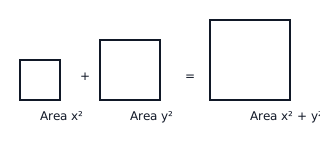
Combining two squares: If you have two separate squares with side lengths and , the area of a new square formed by the sum of their areas will have a side length such that .
Pythagorean triplets are sets of three positive integers that satisfy the relation . Common examples include and .
The converse of the theorem is also true: if the sum of the squares of two sides of a triangle equals the square of the third side, then the triangle must be a right-angled triangle.
📐Formulae
💡Examples
Problem 1:
A square has a side of and another square has a side of . If these two squares are combined to form a new larger square, what will be the length of the side of the new square?
Solution:
Let the side of the first square be and the second square be . The area of the new square is the sum of the areas of the two squares: To find the total area:
Explanation:
According to the Baudhayana-Pythagoras theorem, the side of a square whose area is the sum of two other squares is the hypotenuse of a right triangle with the given sides.
Problem 2:
Find a Pythagorean triplet whose smallest member is .
Solution:
We use the general form of a triplet . Let , which gives . Now, find the other two members:
- The triplet is . Check:
Explanation:
By setting the even number to the part of the formula, we can solve for and then find the remaining sides of the right-angled triangle.
Problem 3:
In a right-angled triangle, the hypotenuse is and one side is . Find the third side.
Solution:
Let the hypotenuse be and one side be . We need to find . Using : To find the difference:
Explanation:
We rearrange the formula to solve for a leg: , and then take the square root of the result.
Problem 4:
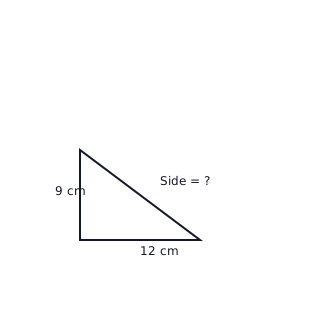
Two squares have sides and respectively. Find the side length of a third square whose area is equal to the sum of the areas of these two squares.
Solution:
Explanation:
The side of the new square is the hypotenuse of a right triangle where the other two sides are and .
Problem 5:
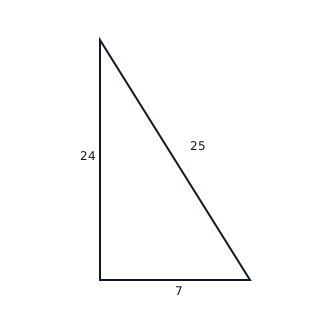
Verify if is a Pythagorean triplet.
Solution:
Explanation:
We calculate the squares of the two smaller numbers and check if their sum equals the square of the largest number.