
Review the key concepts, formulae, and examples before starting your quiz.
🔑Concepts
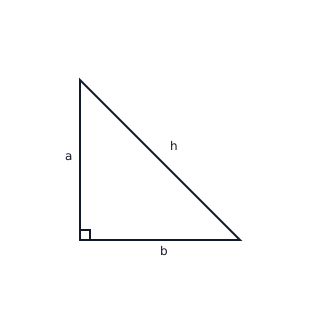
The Baudhayana-Pythagoras theorem states that in a right-angled triangle, the square of the hypotenuse is equal to the sum of the squares of the other two sides: .
An Isosceles Right Triangle is a special case where the two legs (base and perpendicular) are equal in length ().
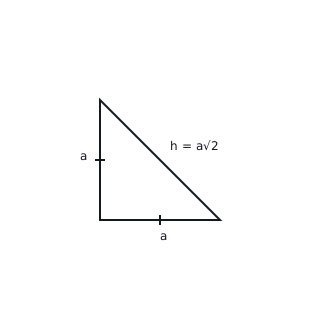
In an isosceles right triangle, the relationship between the hypotenuse and equal sides simplifies to , which implies .
The value of is approximately , which can be used for numerical estimations of the hypotenuse length.
📐Formulae
💡Examples
Problem 1:
Find the length of the hypotenuse of an isosceles right triangle whose equal sides are each long.
Solution:
Let the equal sides be . According to the Baudhayana-Pythagoras theorem:
Explanation:
Since the triangle is an isosceles right triangle, we substitute the side length into the derived formula .
Problem 2:
If the hypotenuse of an isosceles right triangle is , find the length of its equal sides.
Solution:
Let the equal sides be . The hypotenuse . Using the formula : Dividing by :
Explanation:
We use the relationship for isosceles right triangles where the square of the hypotenuse is twice the square of one side, then solve for the side length.
Problem 3:
Verify the Baudhayana theorem for a triangle with sides , , and hypotenuse .
Solution:
The two equal sides are and . The hypotenuse is . Calculate : Calculate : Since , the theorem is verified.
Explanation:
By squaring the legs and the hypotenuse, we show that the sum of the squares of the legs equals the square of the hypotenuse.
Problem 4:
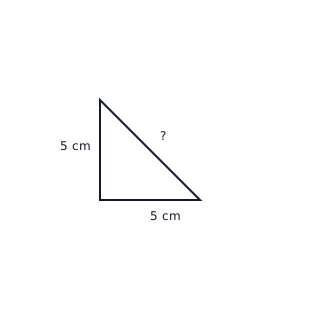
Calculate the hypotenuse of an isosceles right triangle if each of the equal sides measures .
Solution:
Given side . Using the formula for isosceles right triangles: Alternatively: Using :
Explanation:
Since both sides are equal, we apply the Pythagoras theorem where both the base and perpendicular are 5 cm.
Problem 5:
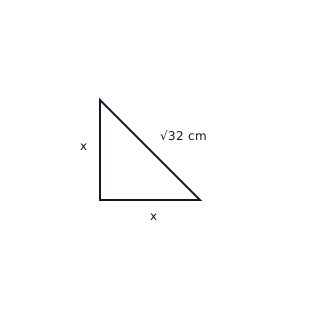
The hypotenuse of an isosceles right triangle is . Find the length of the equal sides.
Solution:
Let the length of each equal side be . Given . Using the formula : Thus, the equal sides are each.
Explanation:
We use the relationship between the hypotenuse and the sides of an isosceles right triangle to solve for the side length.