
Review the key concepts, formulae, and examples before starting your quiz.
🔑Concepts
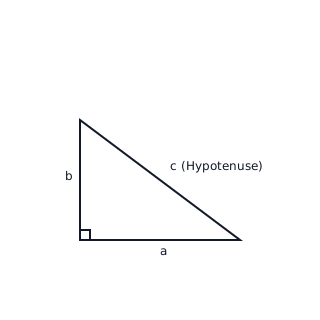
The Baudhayana-Pythagoras theorem states that in a right-angled triangle, the area of the square on the hypotenuse (the side opposite the right angle) is equal to the sum of the areas of the squares on the other two sides. Ancient Indian mathematician Baudhayana expressed this as: 'The diagonal of an oblong produces by itself both the areas which the two sides produce separately.' This is mathematically represented as .
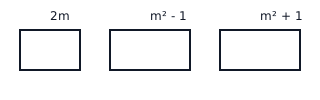
A 'Pythagorean Triplet' consists of three positive integers and , such that . For any natural number , a general form of a triplet can be generated using . This provides a systematic way to find sets of numbers that satisfy the theorem without trial and error.
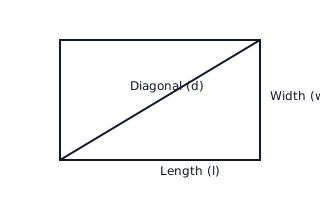
The theorem is widely used to find the length of the diagonal of a rectangle. If a rectangle has length and breadth , the diagonal forms a right-angled triangle with the sides. Thus, .
The theorem also applies to real-world distance problems, such as finding the shortest distance between two points on a coordinate plane or determining the height reached by a ladder leaning against a wall.
📐Formulae
💡Examples
Problem 1:
Verify if the numbers form a Pythagorean triplet.
Solution:
Let , , and . Calculating squares: Check the sum: Since , we have .
Explanation:
To check for a triplet, we square the two smaller numbers and see if their sum equals the square of the largest number.
Problem 2:
Find the length of the diagonal of a rectangle whose length is and breadth is .
Solution:
In a rectangle, the diagonal forms a right-angled triangle with the length and breadth. Let and . Using the Baudhayana-Pythagoras theorem: The diagonal is .
Explanation:
The diagonal of a rectangle acts as the hypotenuse. We calculate the square of the sides, add them, and find the square root of the result.
Problem 3:
Write a Pythagorean triplet whose smallest member is .
Solution:
Let , which gives . Now find the other two members: The triplet is . Check: .
Explanation:
We use the general form to derive the triplet starting from the even number given.
Problem 4:
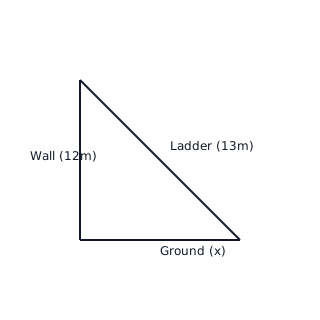
A long ladder is placed against a wall such that it reaches a window high. Find the distance of the foot of the ladder from the base of the wall.
Solution:
Let the distance of the foot of the ladder from the wall be . In the right-angled triangle formed: Hypotenuse (ladder length) Height (wall) Base (distance) By Baudhayana-Pythagoras theorem: The foot of the ladder is away from the wall.
Explanation:
We model the wall, ground, and ladder as a right-angled triangle. The ladder acts as the hypotenuse. We substitute the known values into the formula and solve for the unknown base.
Problem 5:
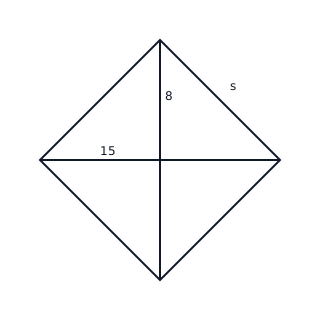
Calculate the perimeter of a rhombus whose diagonals measure and .
Solution:
In a rhombus, diagonals bisect each other at right angles (). Let the diagonals be and . Half of the diagonals are and . These half-diagonals form the legs of a right-angled triangle where the side of the rhombus is the hypotenuse (). By Baudhayana-Pythagoras theorem: Perimeter of rhombus Perimeter .
Explanation:
Using the property that rhombus diagonals bisect perpendicularly, we find the side length using the theorem on one of the four internal triangles, then multiply by 4 for the total perimeter.