
Review the key concepts, formulae, and examples before starting your quiz.
🔑Concepts
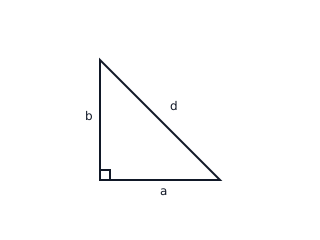
The Baudhayana-Pythagoras Theorem states that in a right-angled triangle, the square of the hypotenuse is equal to the sum of the squares of the other two sides. In ancient Indian mathematics, Baudhayana described this as the 'diagonal of a rectangle producing as much area as the two sides produce together'.
Doubling a Square: If we take a square with side , its area is . When we construct a new square using the diagonal of the original square as its side, the area of this new square is exactly double the area of the original square ().
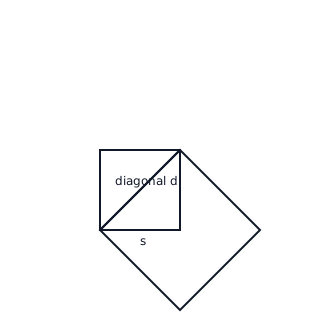
Mathematical relationship: For a square of side and diagonal , the area of the square on the diagonal is . This provides a geometric method to find a square with twice the area of a given square.
The length of the diagonal can be calculated as . This represents the ratio of the diagonal of a square to its side.
📐Formulae
💡Examples
Problem 1:
If a square has a side of , find the area of the square formed by using its diagonal as a side.
Solution:
Given side . Area of original square = . According to the Baudhayana-Pythagoras Theorem, the square of the diagonal is: .
Explanation:
The area of the square formed by the diagonal is exactly twice the area of the original square. Since the original area is , the new area is .
Problem 2:
Verify the doubling of a square with side and calculate the increase in area using vertical subtraction.
Solution:
Original Area . New Area (Doubled) . Difference in area: The increase in area is .
Explanation:
By using the diagonal as the side of a new square, the area is doubled. Subtracting the original area from the new area shows that the area added is equal to the original area.
Problem 3:
A square has a side length of . Find the area of a second square whose side is equal to the diagonal of the first square.

Solution:
Explanation:
According to the property of doubling a square, the area of the square built on the diagonal is twice the area of the original square.
Problem 4:
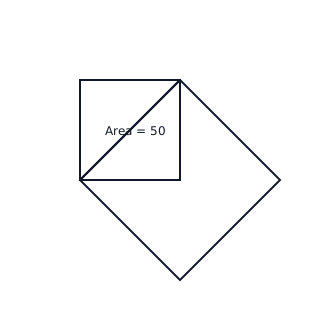
A square garden has an area of . If a path is constructed along its diagonal to form a larger square, find the area of this larger square and the difference in area between the two squares.
Solution:
Explanation:
Since the larger square is formed using the diagonal of the smaller square, its area is double the smaller square's area. The difference is simply the area of the original square.