
Review the key concepts, formulae, and examples before starting your quiz.
🔑Concepts
The Baudhayana-Pythagoras theorem provides a method to construct a square whose area is exactly half of a given square by connecting the midpoints of the adjacent sides.
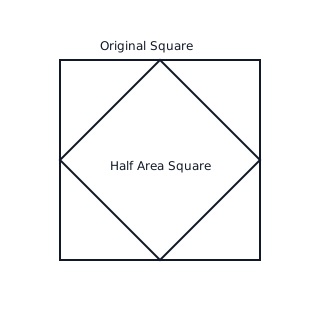
If the side of the original square is , its area is . The side of the new square formed by joining the midpoints is , resulting in an area of .
According to Baudhayana's Sulba Sutras, the diagonal of a square produces an area twice as large as the original square. Conversely, the side of a square is the diagonal of a square with half the area.
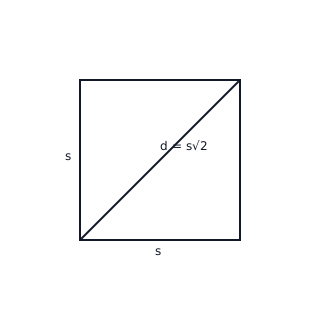
This geometric halving is a practical application of the Baudhayana-Pythagoras theorem () where and are the half-lengths of the original square's sides.
📐Formulae
💡Examples
Problem 1:
A square has a side length of . Find the area of the square formed by joining the midpoints of its sides.
Solution:
- Area of the original square: .
- According to the property of halving a square, the area of the inner square is half of the original.
- .
Explanation:
By joining the midpoints, we effectively create four right-angled triangles at the corners. Each triangle has a base and height of (half the side). Using the Baudhayana-Pythagoras theorem, the side of the inner square is . The area is thus .
Problem 2:
Calculate the difference in area between a square of side and a square formed by halving it through its midpoints.
Solution:
Area of outer square: Area of inner square: Difference in area: The difference is .
Explanation:
The area of the square formed by joining midpoints is always half of the parent square. Subtracting half from the whole leaves the other half as the difference.
Problem 3:
Find the length of the diagonal of a square whose side is .
Solution:
Using the Baudhayana-Pythagoras Theorem for the diagonal : Using :
Explanation:
The diagonal of a square acts as the hypotenuse of a right-angled triangle where the legs are the sides of the square.
Problem 4:
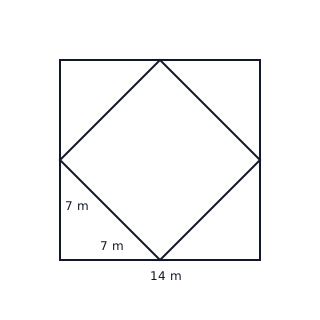
A square plot has a side of . A smaller square garden is designed inside it by joining the midpoints of the sides of the plot. Calculate the side length of this garden.
Solution:
Explanation:
When midpoints of a square with side are joined, the side of the inner square forms the hypotenuse of a right triangle with legs . Using , we get , which simplifies to .
Problem 5:
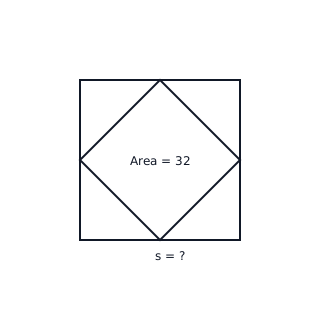
The area of a square formed by joining the midpoints of a larger square is . What is the side length of the larger square?
Solution:
Explanation:
Since the inner square (joining midpoints) has exactly half the area of the outer square, we multiply the inner area by 2 to find the outer area. The side length is then the square root of that area.