
The Baudhayana-Pythagoras Theorem - Further Applications of the Baudhāyana-Pythagoras Theorem
Review the key concepts, formulae, and examples before starting your quiz.
🔑Concepts
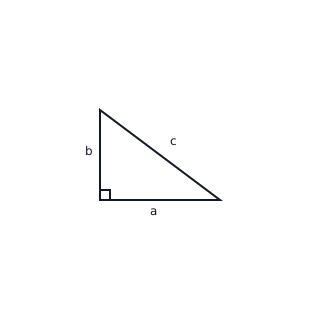
The Baudhāyana-Pythagoras theorem states that in a right-angled triangle, the square of the hypotenuse is equal to the sum of the squares of the other two sides. This can be visualized as the area of a square built on the longest side being equal to the combined areas of squares built on the legs.
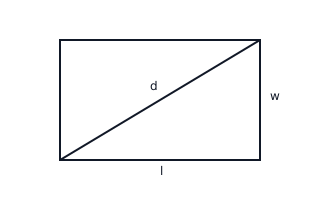
In a rectangle, the diagonal divides the rectangle into two identical right-angled triangles. The length of the diagonal can be calculated using the length and breadth of the rectangle as .
For an isosceles triangle, the altitude (height) drawn from the vertex between equal sides to the base bisects the base. This creates two right-angled triangles where the hypotenuse is the equal side , one leg is the height , and the other leg is half the base .
Pythagorean triplets are sets of three positive integers that satisfy . A common way to generate these for any integer is using the forms , , and .
📐Formulae
💡Examples
Problem 1:
A ladder long reaches a window which is above the ground on side of a wall. Find the distance of the foot of the ladder from the wall.
Solution:
Let the distance of the foot of the ladder from the wall be . The ladder, the wall, and the ground form a right-angled triangle where the ladder is the hypotenuse. According to the Baudhāyana-Pythagoras theorem: .
Explanation:
We used the theorem where (ladder) and (wall height). Solving for gives the distance on the ground.
Problem 2:
Find the length of the diagonal of a rectangle whose length is and breadth is .
Solution:
In a rectangle, the diagonal , length , and breadth satisfy the relation: .
Explanation:
The diagonal divides the rectangle into two right-angled triangles. By applying the theorem to one of these triangles, we find the diagonal length.
Problem 3:
Write a Pythagorean triplet whose smallest member is .
Solution:
Using the general form : Let Then, And, Check: . The triplet is .
Explanation:
We identify from the given even number and use the standard algebraic identities for Pythagorean triplets to find the other two numbers.
Problem 4:
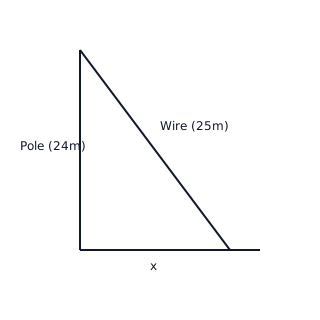
A wire of length is attached to the top of a vertical pole of height . How far from the base of the pole should the other end of the wire be anchored to the ground so that the wire is taut?
Solution:
Let be the height of the pole, be the length of the wire (hypotenuse), and be the distance from the base. Given: , . Using the Baudhāyana-Pythagoras theorem: The wire should be anchored from the base.
Explanation:
The pole, the ground, and the wire form a right-angled triangle where the wire is the hypotenuse. We solve for the unknown base using the square root of the difference between the squares of the hypotenuse and the height.
Problem 5:
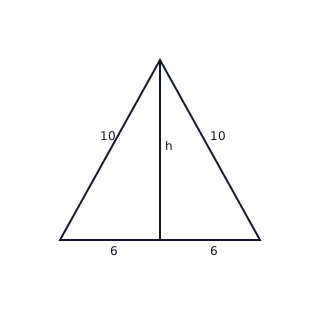
An isosceles triangle has equal sides of each and a base of . Calculate the altitude of the triangle.
Solution:
In an isosceles triangle, the altitude bisects the base . Base , so half the base is . The equal side acts as the hypotenuse for the right triangle formed by the altitude. The altitude of the triangle is .
Explanation:
By drawing an altitude, we split the isosceles triangle into two right-angled triangles. We then use the Pythagoras theorem on one of these triangles with a base of and hypotenuse of .