krit.club logo

Geometry - The Triangle and its Properties: Angle Sum Property, Exterior Angle Property

Grade 7ICSE

Review the key concepts, formulae, and examples before starting your quiz.

🔑Concepts

•

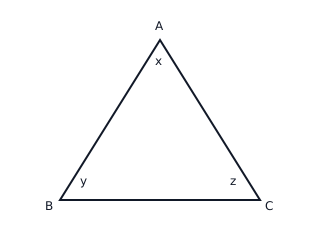
The Angle Sum Property of a triangle states that the sum of the interior angles of any triangle is always 180∘180^\circ. If a triangle has angles ∠A\angle A, ∠B\angle B, and ∠C\angle C, then ∠A+∠B+∠C=180∘\angle A + \angle B + \angle C = 180^\circ.

Triangle ABC with internal angles x, y, and z summing to 180 degrees.
•

The Exterior Angle Property states that if a side of a triangle is produced, the exterior angle so formed is equal to the sum of the two interior opposite angles.
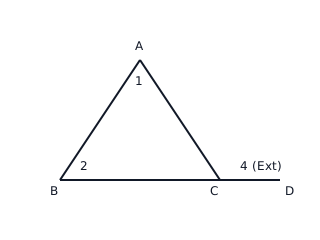
Triangle ABC with side BC extended to D, showing exterior angle ACD.
•

The exterior angle and its adjacent interior angle form a linear pair, meaning their sum is always 180∘180^\circ.

•

In an equilateral triangle, each interior angle measures 60∘60^\circ, and each exterior angle measures 120∘120^\circ.

📐Formulae

∠1+∠2+∠3=180∘\angle 1 + \angle 2 + \angle 3 = 180^\circ

Exterior ∠=Sum of interior opposite \angles\text{Exterior } \angle = \text{Sum of interior opposite } \angles

∠ext=∠int1+∠int2\angle \text{ext} = \angle \text{int1} + \angle \text{int2}

Interior ∠+Adjacent Exterior ∠=180∘\text{Interior } \angle + \text{Adjacent Exterior } \angle = 180^\circ

💡Examples

Problem 1:

In △PQR\triangle PQR, the measures of ∠P\angle P and ∠Q\angle Q are 45∘45^\circ and 75∘75^\circ respectively. Find the measure of ∠R\angle R.

Solution:

  1. According to the Angle Sum Property: ∠P+∠Q+∠R=180∘\angle P + \angle Q + \angle R = 180^\circ
  2. Substitute the given values: 45∘+75∘+∠R=180∘45^\circ + 75^\circ + \angle R = 180^\circ
  3. Add the known angles: 120∘+∠R=180∘120^\circ + \angle R = 180^\circ
  4. Subtract 120∘120^\circ from both sides: ∠R=180∘−120∘\angle R = 180^\circ - 120^\circ
  5. ∠R=60∘\angle R = 60^\circ

Explanation:

To find a missing interior angle when two are known, we use the property that all three must add up to 180∘180^\circ.

Problem 2:

In △ABC\triangle ABC, the side BCBC is produced to DD. If the exterior angle ∠ACD=115∘\angle ACD = 115^\circ and the interior opposite angle ∠A=50∘\angle A = 50^\circ, find the measure of ∠B\angle B.

Solution:

  1. By the Exterior Angle Property: Exterior ∠ACD=∠A+∠B\text{Exterior } \angle ACD = \angle A + \angle B
  2. Substitute the known values: 115∘=50∘+∠B115^\circ = 50^\circ + \angle B
  3. Rearrange the equation to solve for ∠B\angle B: ∠B=115∘−50∘\angle B = 115^\circ - 50^\circ
  4. ∠B=65∘\angle B = 65^\circ

Explanation:

The exterior angle is always equal to the sum of the two interior angles that are not adjacent to it. By subtracting the given interior opposite angle from the exterior angle, we find the second interior opposite angle.

Problem 3:

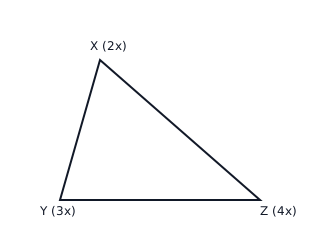
In △XYZ\triangle XYZ, the measures of angles ∠X\angle X, ∠Y\angle Y and ∠Z\angle Z are in the ratio 2:3:42:3:4. Find the measure of each angle.

Triangle XYZ with angles labeled as ratios 2x, 3x, and 4x.

Solution:

Let the measures of the angles be 2x2x, 3x3x, and 4x4x. By the Angle Sum Property: 2x+3x+4x=180∘2x + 3x + 4x = 180^\circ 9x=180∘9x = 180^\circ x=180∘9=20∘x = \frac{180^\circ}{9} = 20^\circ Now find the individual angles: ∠X=2×20∘=40∘\angle X = 2 \times 20^\circ = 40^\circ ∠Y=3×20∘=60∘\angle Y = 3 \times 20^\circ = 60^\circ ∠Z=4×20∘=80∘\angle Z = 4 \times 20^\circ = 80^\circ Verification: 40∘+60∘+80∘=180∘40^\circ + 60^\circ + 80^\circ = 180^\circ.

Explanation:

This problem uses the Angle Sum Property of triangles. By representing the unknown angles as multiples of a common variable xx based on the given ratio, we can solve a linear equation set to 180∘180^\circ.

Problem 4:

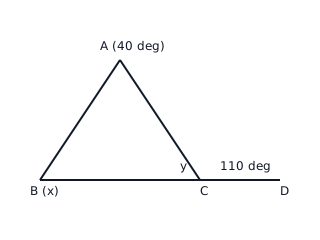
In the given figure, find the value of xx and yy if ∠BAC=40∘\angle BAC = 40^\circ and the exterior ∠ACD=110∘\angle ACD = 110^\circ.

Triangle ABC with an exterior angle of 110 degrees and vertex angle A of 40 degrees.

Solution:

Using the Exterior Angle Property: Ext ∠ACD=∠BAC+∠ABC\text{Ext } \angle ACD = \angle BAC + \angle ABC 110∘=40∘+x110^\circ = 40^\circ + x x=110∘−40∘=70∘x = 110^\circ - 40^\circ = 70^\circ Now, using the Linear Pair property at vertex CC: ∠ACB+∠ACD=180∘\angle ACB + \angle ACD = 180^\circ y+110∘=180∘y + 110^\circ = 180^\circ y=180∘−110∘=70∘y = 180^\circ - 110^\circ = 70^\circ Alternatively, using Angle Sum Property: 40∘+x+y=180∘40^\circ + x + y = 180^\circ 40∘+70∘+y=180∘40^\circ + 70^\circ + y = 180^\circ 110∘+y=180∘  ⟹  y=70∘110^\circ + y = 180^\circ \implies y = 70^\circ.

Explanation:

We first apply the Exterior Angle Property to find the interior opposite angle xx. Then, we use either the linear pair relationship or the angle sum property of the triangle to find the third interior angle yy.