
Review the key concepts, formulae, and examples before starting your quiz.
🔑Concepts
Congruence of Triangles: Two triangles are congruent if they are identical in shape and size. This means their corresponding sides and corresponding angles are equal. We use the symbol to denote congruence. For example, means , , , , , and .
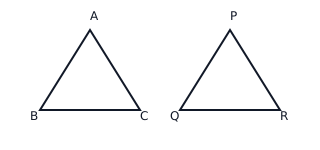
SSS (Side-Side-Side) Criterion: Two triangles are congruent if the three sides of one triangle are equal to the three corresponding sides of the other triangle.
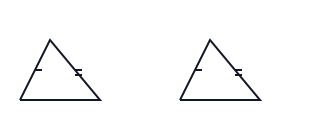
SAS (Side-Angle-Side) Criterion: Two triangles are congruent if two sides and the included angle of one triangle are equal to the corresponding two sides and the included angle of the other triangle.
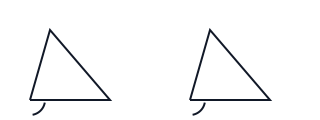
ASA (Angle-Side-Angle) Criterion: Two triangles are congruent if two angles and the included side of one triangle are equal to the corresponding two angles and the included side of the other triangle.
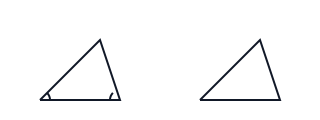
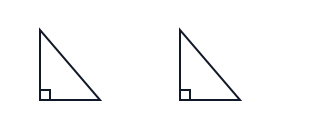
RHS (Right Angle-Hypotenuse-Side) Criterion: Two right-angled triangles are congruent if the hypotenuse and one side of one triangle are equal to the hypotenuse and one side of the other triangle.
📐Formulae
Congruence Symbol:
SSS Condition:
SAS Condition:
ASA Condition:
RHS Condition:
Angle Sum Property:
💡Examples
Problem 1:
In and , it is given that , , and . In , , , and . Are the triangles congruent? If yes, state the criterion.
Solution:
- Compare the given components:
- Side of = Side of
- Side of = Side of
- Included of = Included of
- Since two sides and the included angle of are equal to the corresponding parts of , the triangles satisfy the SAS criterion.
- Therefore, by SAS congruence criterion.
Explanation:
We identify that the given angle is the 'included angle' (the angle formed between the two known sides). Since the side-angle-side sequence matches in both triangles, they are congruent by SAS.
Problem 2:
In an isosceles , . If is the perpendicular dropped from to the base , prove that .
Solution:
In and :
- (Given that )
- Hypotenuse Hypotenuse (Given as an isosceles triangle)
- Side Side (Common side to both triangles)
- By the RHS criterion, .
Explanation:
To prove congruence in right-angled triangles formed by an altitude, we look for the Right angle, the Hypotenuse, and one common or given Side. Here, is common, and the slanted sides of the isosceles triangle act as equal hypotenuses.
Problem 3:
In the given figure, bisects and . Prove that using the ASA criterion.
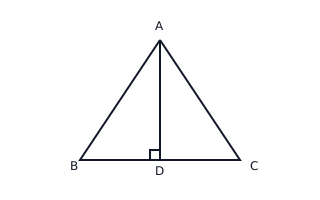
Solution:
In and :
- (Given, bisects )
- (Common side)
- (Given, ) Therefore, by ASA Congruence Criterion.
Explanation:
To use ASA, we identify two angles and the side between them. Here, the side is shared, and the angles on either side of this segment are equal due to the bisector and perpendicularity conditions.
Problem 4:
In the figure, is the mid-point of and . Prove that and hence .
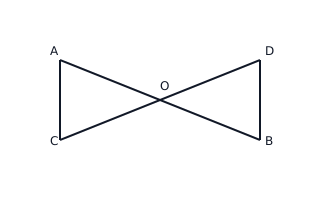
Solution:
In and :
- ( is the mid-point of )
- (Vertically opposite angles)
- ( is the mid-point of ) Therefore, by SAS Congruence Criterion. By CPCT (Corresponding Parts of Congruent Triangles), .
Explanation:
Since is the midpoint of both segments, the segments are divided into equal halves. The angles formed at the intersection are vertically opposite and thus equal, satisfying the Side-Angle-Side condition.