
Review the key concepts, formulae, and examples before starting your quiz.
🔑Concepts
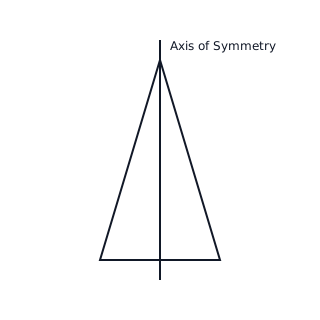
Line Symmetry (Reflectional Symmetry): A figure has line symmetry if a line can be drawn dividing the figure into two identical parts that are mirror images of each other. This line is called the axis of symmetry.
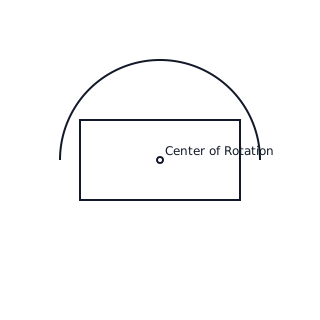
Rotational Symmetry: A figure has rotational symmetry if it looks exactly the same more than once during a full turn around its center. The fixed point is called the Center of Rotation.
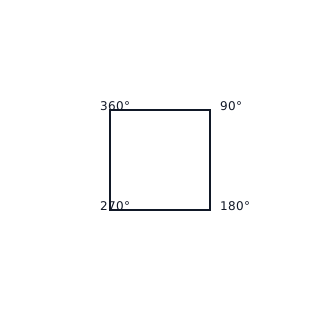
Order of Rotational Symmetry: This is the number of times a figure fits onto itself in one complete rotation of . For example, a square has an order of 4.
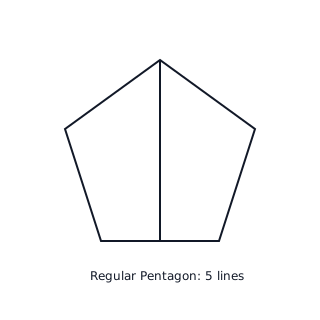
Regular Polygons: A regular polygon with sides has lines of symmetry and an order of rotational symmetry equal to . Each interior angle of rotation is .
📐Formulae
💡Examples
Problem 1:
A regular polygon has an angle of rotation equal to . Identify the polygon and determine its number of lines of symmetry.
Solution:
Step 1: Use the formula for the order of rotational symmetry: Step 2: Substitute the given value: Step 3: Since the order of rotation is and it is a regular polygon, the number of sides . A -sided regular polygon is a Regular Pentagon. Step 4: For a regular polygon, the number of lines of symmetry equals the number of sides. Therefore, the number of lines of symmetry is .
Explanation:
We first find the order of rotational symmetry using the division rule, which tells us the number of sides of the regular polygon. Once the polygon is identified, we apply the property that regular polygons have lines of symmetry equal to their side count.
Problem 2:
Consider a rectangle that is not a square. List its lines of symmetry and its order of rotational symmetry.
Solution:
Step 1: Visualize the lines of symmetry. A rectangle has two lines of symmetry: one horizontal line passing through the midpoints of the shorter sides, and one vertical line passing through the midpoints of the longer sides. Note: The diagonals of a non-square rectangle are NOT lines of symmetry. Step 2: Calculate rotational symmetry.
- At rotation, the rectangle stands vertically (different from the original).
- At rotation, it looks identical to the original.
- At rotation, it stands vertically again.
- At rotation, it returns to the original position. Step 3: The rectangle looks identical times during a full turn. So, the Order of Rotational Symmetry is .
Explanation:
This example distinguishes between a square and a rectangle. While a square has lines of symmetry, a rectangle only has . Its rotational symmetry is confirmed by checking how many times it matches its original orientation within a full circle.
Problem 3:
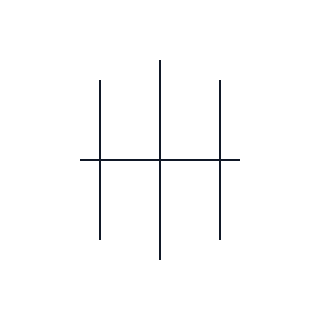
Examine the letter 'H'. State the number of lines of symmetry and the order of rotational symmetry.
Solution:
- Lines of Symmetry: The letter 'H' can be folded horizontally and vertically to match perfectly. So, it has 2 lines of symmetry.
- Rotational Symmetry: When rotated by and , it looks the same. The order of rotational symmetry is 2.
Explanation:
Objects like 'H' possess both vertical and horizontal reflectional symmetry. Since it fits onto itself twice in a full circle, the order is .
Problem 4:
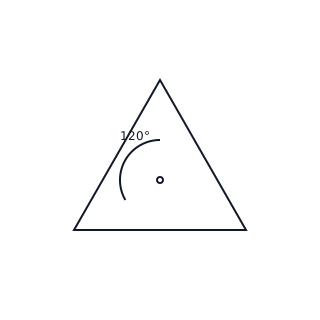
An equilateral triangle is rotated about its center. Determine the minimum angle of rotation required for the triangle to occupy the same position, and find its order of rotational symmetry.
Solution:
- Order of Rotational Symmetry: A regular polygon with sides has an order of . For an equilateral triangle, .
- Angle of Rotation: .
Explanation:
In an equilateral triangle, rotating by moves each vertex to the position of the next vertex, making the shape look unchanged.