
Geometry - Parallel Lines and Transversal: Corresponding Angles, Alternate Angles, Interior Angles
Review the key concepts, formulae, and examples before starting your quiz.
🔑Concepts
A transversal is a line that intersects two or more lines at distinct points. When a transversal intersects two parallel lines, specific pairs of angles are formed: Corresponding, Alternate, and Interior angles.
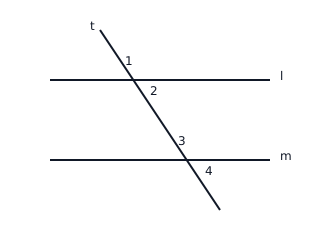
Corresponding Angles: These are pairs of angles in similar positions at each intersection. If the lines are parallel, corresponding angles are equal, such as .
Alternate Interior Angles: These are pairs of angles on opposite sides of the transversal and between the two lines. For parallel lines, they are equal (e.g., ).
Co-interior (Consecutive Interior) Angles: These are pairs of angles on the same side of the transversal and between the two lines. For parallel lines, they are supplementary, meaning their sum is .
📐Formulae
If , then Corresponding Angles:
If , then Alternate Interior/Exterior Angles:
If , then Co-interior Angles:
Linear Pair:
Vertically Opposite Angles:
💡Examples
Problem 1:
In a figure where and a transversal intersects them, one of the alternate interior angles is given as and the other is . Find the value of .
Solution:
- Since the lines are parallel, alternate interior angles must be equal.
- Set up the equation:
- Add to both sides:
- Divide by :
Explanation:
This problem applies the property that alternate interior angles are equal when a transversal intersects parallel lines. We create an algebraic equation to solve for the unknown variable.
Problem 2:
Two parallel lines are cut by a transversal. If the interior angles on the same side of the transversal (co-interior angles) are in the ratio , find the measure of the larger angle.
Solution:
- Let the two co-interior angles be and .
- We know that co-interior angles are supplementary: .
- Combine like terms: .
- Solve for : .
- Find the larger angle: .
Explanation:
We use the property that co-interior angles sum to to establish a linear equation based on the given ratio, then calculate the specific angle requested.
Problem 3:
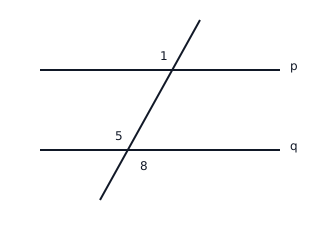
In the given figure, . If , find the measure of and .
Solution:
Since , and are corresponding angles. and form a linear pair.
Explanation:
We use the property that corresponding angles of parallel lines are equal to find , and the linear pair property to find .
Problem 4:
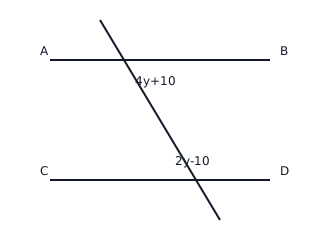
Given , find the value of if the interior angles on the same side of the transversal are and .
Solution:
Interior angles on the same side of a transversal of parallel lines are supplementary.
Explanation:
Co-interior angles between parallel lines always sum to . We set up an equation with the given algebraic expressions and solve for .