
Review the key concepts, formulae, and examples before starting your quiz.
🔑Concepts
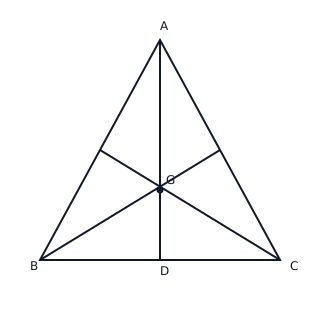
A median of a triangle is a line segment joining a vertex to the midpoint of the opposite side. Every triangle has exactly three medians, which are always concurrent at a single point called the Centroid (). The centroid divides each median in the ratio from the vertex.
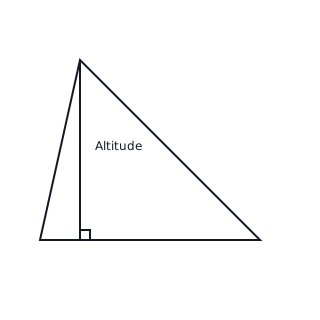
An altitude is a perpendicular segment from a vertex to the line containing the opposite side. The length of the altitude is the height of the triangle. The three altitudes of a triangle meet at a point called the Orthocenter ().
In an equilateral triangle, the medians and altitudes are identical. This means the centroid and the orthocenter coincide at the same point.
For an obtuse-angled triangle, the orthocenter lies outside the triangle because two of the altitudes must be drawn to the extensions of the sides.
📐Formulae
💡Examples
Problem 1:
In , is a median and is the centroid. If the length of the median is , find the lengths of the segments and .
Solution:
- We know that the centroid divides the median in the ratio from the vertex .
- Therefore, .
- .
- Similarly, .
- .
- Verification: , which matches the total length of the median.
Explanation:
The problem uses the property that the centroid divides the median into two parts in a ratio, where the part connected to the vertex is longer.
Problem 2:
In a right-angled triangle where , the sides and . Identify the lengths of the altitudes from vertex to side and from vertex to side . Also, name the orthocenter.
Solution:
- An altitude is a perpendicular from a vertex to the opposite side.
- In a right-angled triangle, the legs are perpendicular to each other.
- The altitude from to is the side itself, so length .
- The altitude from to is the side itself, so length .
- Since the altitudes and meet at vertex , and the third altitude from to the hypotenuse also passes through , the orthocenter is the vertex .
Explanation:
This example demonstrates that in a right-angled triangle, the two legs act as altitudes for each other, and the vertex containing the right angle is the orthocenter.
Problem 3:
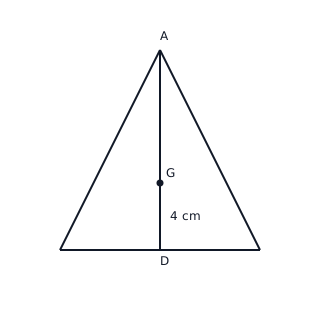
In , is a median and is the centroid. If , calculate the lengths of and the whole median .
Solution:
- We know that the centroid divides the median in the ratio .
- Given .
- Since , we have .
- The total length of the median .
Explanation:
The centroid property states that the distance from the vertex to the centroid is twice the distance from the centroid to the midpoint of the side.
Problem 4:
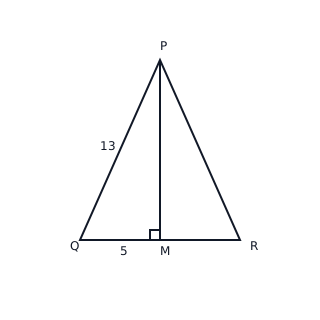
An isosceles triangle has and . Calculate the length of the altitude drawn from to .
Solution:
- In an isosceles triangle, the altitude to the base also acts as a median. Therefore, is the midpoint of .
- .
- In right-angled , using Pythagoras theorem: $$PM = \sqrt{144} = 12 \text{ cm}$.
Explanation:
In isosceles triangles, the altitude from the vertex between equal sides bisects the base. This creates a right-angled triangle where the altitude can be found using the Pythagorean theorem.