
Geometry - Lines and Angles: Pairs of angles (Complementary, Supplementary, Adjacent, Vertically Opposite)
Review the key concepts, formulae, and examples before starting your quiz.
🔑Concepts
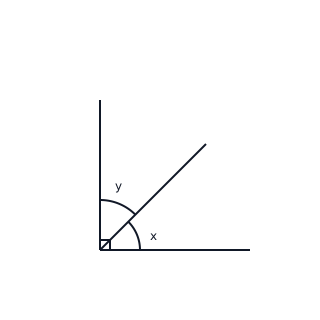
Complementary Angles: Two angles are said to be complementary if the sum of their measures is . Each angle is called the complement of the other. When placed adjacent to each other, they form a right angle.
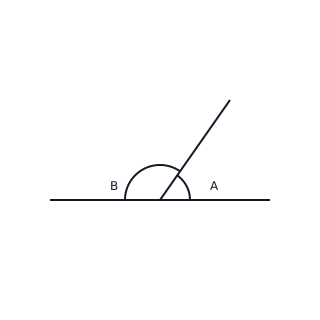
Supplementary Angles: Two angles are supplementary if their sum is . They form a straight line when placed together as a linear pair. One angle is the supplement of the other.
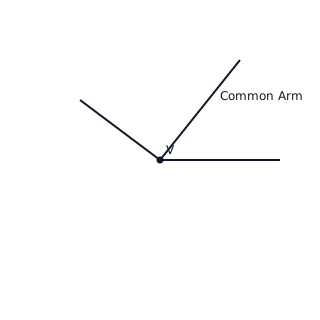
Adjacent Angles: Two angles are adjacent if they have a common vertex, a common arm, and their non-common arms lie on opposite sides of the common arm.
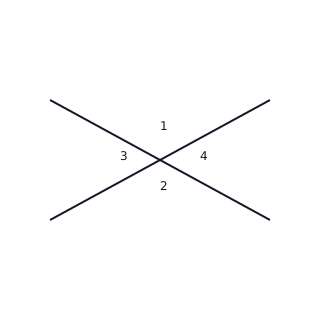
Vertically Opposite Angles: When two lines intersect at a point, the angles formed opposite to each other are called vertically opposite angles. They are always equal.
📐Formulae
Complementary Condition:
Supplementary Condition:
Measure of Complement:
Measure of Supplement:
Vertically Opposite Angles: If lines and intersect at , then and
Sum of Angles in a Linear Pair:
💡Examples
Problem 1:
Find the measure of an angle which is less than its supplement.
Solution:
- Let the angle be .
- Its supplement is .
- According to the question: .
- Simplify: .
- Move to one side: .
- Solve for : .
Explanation:
We use the definition of supplementary angles (sum = ) and set up a linear equation based on the given relationship.
Problem 2:
In an 'X' shape formed by two intersecting lines, one of the angles is and its vertically opposite angle is . Find the value of and the measure of these angles.
Solution:
- Since vertically opposite angles are equal, we set the expressions equal to each other: .
- Subtract from both sides: .
- Add to both sides: .
- Substitute back into either expression: .
- Therefore, both vertically opposite angles are .
Explanation:
We apply the property that vertically opposite angles are always equal to solve for the unknown variable and then calculate the specific angle measure.
Problem 3:
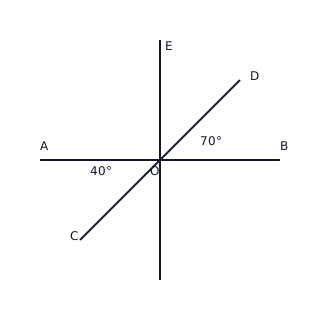
In the given figure, three lines intersect at a point . If and , find the value of .
Solution:
- and are vertically opposite angles. Therefore, .
- Points do not lie on a straight line, but let's look at the straight line (assuming is a line). If and are intersecting lines, .
- However, based on the vertically opposite property: is vertically opposite to (if we name the lines).
- Let's solve for assuming is a straight line: .
- .
- Since is a straight line, .
Explanation:
We use the property that angles on a straight line sum up to and vertically opposite angles are equal to find missing measures.
Problem 4:
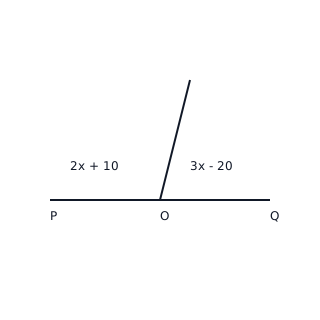
Find the value of in the following figure where and form a linear pair.
Solution:
- Since the angles form a linear pair, their sum is .
- The equation is: .
- Combine like terms: .
- Add 10 to both sides: .
- Divide by 5: .
- The angles are:
Explanation:
A linear pair consists of adjacent angles whose sum is always . By setting up an algebraic equation, we can solve for the unknown variable .