
Review the key concepts, formulae, and examples before starting your quiz.
🔑Concepts
Pythagoras' Theorem states that in a right-angled triangle, the square of the hypotenuse (the side opposite the right angle) is equal to the sum of the squares of the other two sides ( and ). This is expressed as .
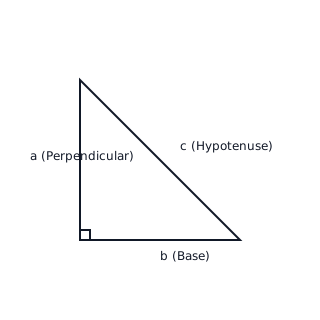
A Pythagorean Triplet consists of three positive integers , , and , such that . Common examples include , , and .
The Converse of Pythagoras' Theorem: If the square of the longest side of a triangle is equal to the sum of the squares of the other two sides, then the triangle must be a right-angled triangle, and the angle opposite the longest side is .
Applications include finding the diagonal of a rectangle. If a rectangle has length and breadth , its diagonal forms the hypotenuse of a right triangle: .
📐Formulae
💡Examples
Problem 1:
A ladder is placed against a wall such that its foot is m away from the wall. If the ladder reaches a window m high on the wall, find the length of the ladder.
Solution:
- Identify the given values: Base () = m, Perpendicular () = m. We need to find the length of the ladder, which is the Hypotenuse ().
- Use the formula:
- Substitute the values:
- Calculate the squares:
- Add the results:
- Find the square root: m.
Explanation:
The wall and ground form a right angle. The ladder forms the hypotenuse. By squaring the distances from the wall and the height of the window, we find the square of the ladder's length.
Problem 2:
The hypotenuse of a right-angled triangle is cm and one of its legs is cm. Find the length of the third side.
Solution:
- Identify the given values: Hypotenuse () = cm, Leg () = cm. We need to find the other Leg ().
- Use the modified formula:
- Substitute the values:
- Calculate the squares:
- Subtract the values:
- Find the square root: cm.
Explanation:
When we know the hypotenuse and one side, we subtract the square of the known side from the square of the hypotenuse to solve for the missing side.
Problem 3:
A rectangle has a length of cm and a diagonal of cm. Calculate the breadth of the rectangle.
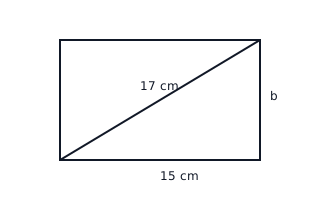
Solution:
Therefore, the breadth is cm.
Explanation:
In a rectangle, the diagonal divides it into two right-angled triangles. We apply Pythagoras' Theorem where the diagonal is the hypotenuse ( cm) and the length is the base ( cm). Solving for the height (breadth) gives cm.
Problem 4:
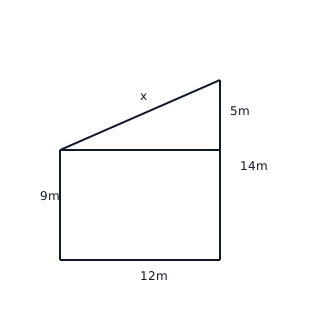
Two poles of heights m and m stand vertically on a plane ground. If the distance between their feet is m, find the distance between their tops.
Solution:
Let the height of the shorter pole be m and the taller pole be m. The distance between feet m. Draw . Then m. m. In right triangle : The distance between the tops is m.
Explanation:
By drawing a horizontal line from the top of the shorter pole to the taller pole, we create a right-angled triangle. The base of this triangle is the distance between the poles ( m) and the height is the difference in pole heights ( m). The hypotenuse is the distance between the tops.