
Review the key concepts, formulae, and examples before starting your quiz.
🔑Concepts
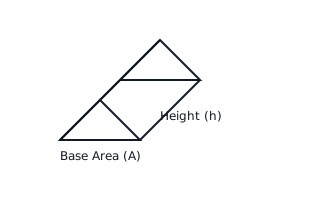
A prism is a 3D shape with a constant cross-section throughout its length. The volume is found by multiplying the area of the base by the height (or length) .
A cylinder is a special type of prism with a circular base. The Total Surface Area () consists of the two circular ends and the rectangular 'label' (curved surface) that wraps around the height.
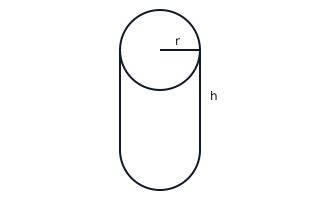
The Surface Area of any prism is the sum of the areas of all its faces. This is calculated as .

To find the volume of composite 3D shapes, divide the object into simpler prisms, calculate each individual volume, and add them together.
📐Formulae
Volume of a General Prism:
Volume of a Cylinder:
Total Surface Area of a General Prism: (where is perimeter)
Curved Surface Area (Lateral Area) of a Cylinder:
Total Surface Area of a Cylinder:
Area of a Triangle (for triangular prisms):
Circumference of a Circle:
💡Examples
Problem 1:
Calculate the volume and total surface area of a triangular prism with a base triangle of base and height . The length (height) of the prism is , and the other two sides of the triangle are each.
Solution:
- Base Area ():
- Volume:
- Base Perimeter ():
- Surface Area:
Explanation:
To find the volume, we first find the area of the triangular cross-section and multiply by the prism's length. For the surface area, we add the areas of the two triangular ends to the area of the three rectangular sides (calculated using Perimeter Height).
Problem 2:
A cylinder has a radius of and a height of . Find its volume and total surface area. (Use )
Solution:
- Volume:
- Surface Area:
Explanation:
For volume, we calculate the area of the circular base () and multiply by the height. For the surface area, we calculate the area of the two circular lids () and add the area of the curved side, which is a rectangle when flattened ().
Problem 3:
A concrete L-shaped prism has a cross-sectional area as shown. The prism is long. Calculate the volume of the prism. The base is an L-shape with a total width of , total height of , and uniform thickness of .
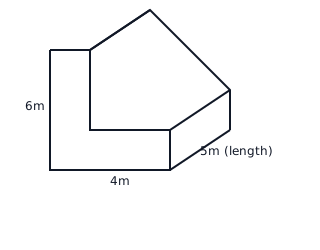
Solution:
- Calculate the area of the L-shaped cross-section by splitting it into two rectangles:
- Rectangle 1 (Bottom):
- Rectangle 2 (Top):
- Total
- Calculate the volume:
Explanation:
To find the volume of any prism, find the area of the uniform cross-section first, then multiply by the length (or height) of the prism.
Problem 4:
A cylindrical water tank is open at the top. The internal radius is and the height is . Calculate the total internal surface area that needs to be waterproofed (the base and the side wall). (Use )
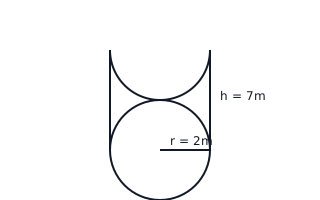
Solution:
- Area of the base (one circle):
- Curved Surface Area ():
- Total Surface Area (Open Top):
Explanation:
Since the tank is 'open at the top', we only calculate the area of the circular base and the curved lateral surface, excluding the top circle.