
Review the key concepts, formulae, and examples before starting your quiz.
🔑Concepts
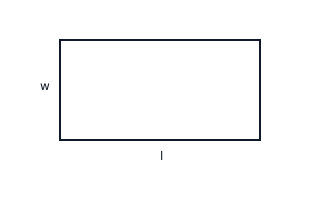
The perimeter of a polygon is the total distance around its boundary, while the area is the space enclosed within it. For a rectangle with length and width , the perimeter is and the area is .
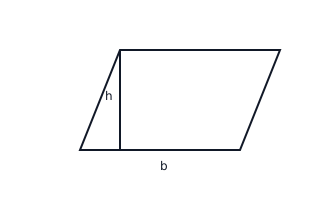
A parallelogram's area is calculated as the product of its base and perpendicular height . Note that the height must be vertical to the base, not the slanted side length.
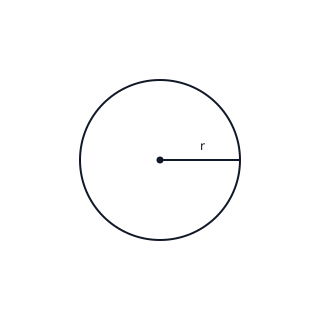
The circumference of a circle is its perimeter, calculated using . The diameter is twice the radius . Area is the square of the radius multiplied by ().
A triangle's area is half of the area of a rectangle with the same base and height: .
For a trapezium, the area is found by taking the average of the two parallel sides ( and ) and multiplying by the vertical height (): .
📐Formulae
Perimeter of a Square:
Area of a Square:
Perimeter of a Rectangle:
Area of a Rectangle:
Area of a Triangle:
Area of a Parallelogram:
Area of a Trapezium:
Circumference of a Circle: or
Area of a Circle:
💡Examples
Problem 1:
Calculate the area and circumference of a circular garden with a radius of m. (Take )
Solution:
- Identify the given radius: m.
- Calculate circumference using : m.
- Calculate area using : .
Explanation:
We substitute the radius into the standard circle formulas. Using the fraction for is helpful here because is a multiple of , allowing for easy simplification.
Problem 2:
A trapezium has parallel sides of length cm and cm. If the perpendicular height between them is cm, find its area.
Solution:
- Identify the parallel sides: cm, cm.
- Identify the height: cm.
- Apply the trapezium area formula:
- Substitute the values:
- Simplify the sum in parentheses:
- Calculate the final result: .
Explanation:
The area is found by taking the sum of the parallel bases, dividing by to find the average length, and then multiplying by the vertical height.
Problem 3:
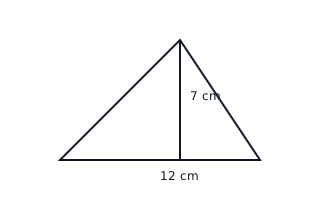
Calculate the area of a triangle with a base of cm and a perpendicular height of cm.
Solution:
Using the formula for the area of a triangle:
Explanation:
To find the area of a triangle, multiply the base by the perpendicular height and then divide the result by 2.
Problem 4:
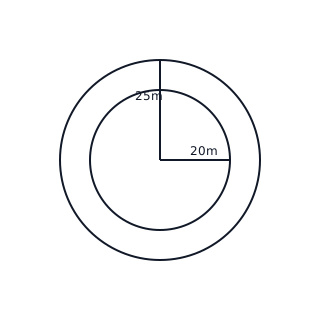
A circular track has an inner radius of m and an outer radius of m. Find the area of the track path. (Use )
Solution:
Area of the track = Area of outer circle - Area of inner circle
Explanation:
The track is the region between two concentric circles. We calculate the area of the larger circle and subtract the area of the smaller circle to find the remaining path area.