
Review the key concepts, formulae, and examples before starting your quiz.
🔑Concepts
The Pythagorean Theorem applies specifically to right-angled triangles. It defines the relationship between the two shorter sides (legs), denoted as and , and the longest side (hypotenuse), denoted as . The theorem states that .
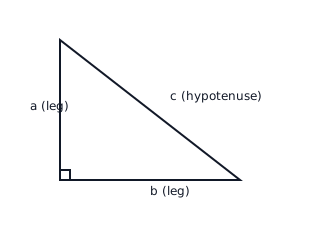
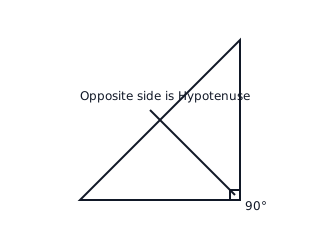
The hypotenuse is always the side opposite the right angle () and is the longest side of the triangle.
A 'Pythagorean Triple' is a set of three positive integers that perfectly satisfy the equation . Common examples include and .
The Converse of the Pythagorean Theorem states that if the square of the longest side of a triangle is equal to the sum of the squares of the other two sides, then the triangle is right-angled.
📐Formulae
💡Examples
Problem 1:
A right-angled triangle has legs of length and . Calculate the length of the hypotenuse.
Solution:
Step 1: Identify the given values: and . Step 2: Use the formula . Step 3: Substitute the values: . Step 4: Square the numbers: . Step 5: Add the squares: . Step 6: Solve for by taking the square root: . Final Answer: The hypotenuse is .
Explanation:
To find the longest side (hypotenuse), we sum the squares of the two shorter sides and then take the square root of that sum.
Problem 2:
The hypotenuse of a right-angled triangle is and one of the legs is . Find the length of the other leg.
Solution:
Step 1: Identify the given values: and . Step 2: Use the rearranged formula for a missing leg: . Step 3: Substitute the values: . Step 4: Square the numbers: . Step 5: Subtract the values: . Step 6: Solve for by taking the square root: . Final Answer: The length of the missing leg is .
Explanation:
When the hypotenuse is already known, we must subtract the square of the known leg from the square of the hypotenuse before taking the square root.
Problem 3:
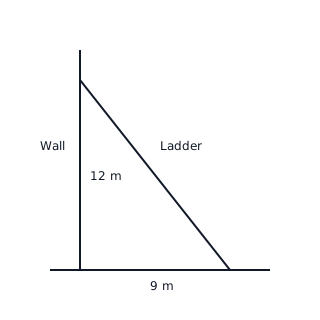
A ladder is leaning against a vertical wall. The base of the ladder is away from the wall, and the ladder reaches a height of up the wall. Calculate the length of the ladder.
Solution:
Explanation:
In this real-world scenario, the wall and the ground form a right angle. The distance from the wall () and the height reached () are the legs of a right-angled triangle. The ladder itself is the hypotenuse. We square both legs, sum them, and take the square root to find the ladder length.
Problem 4:
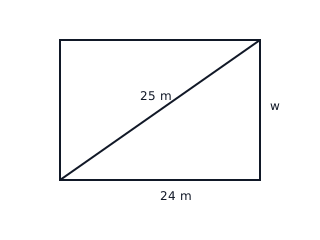
A rectangular field has a length of and a diagonal of . Find the width of the field.
Solution:
Explanation:
A rectangle can be split into two right-angled triangles by its diagonal. Here, the diagonal acts as the hypotenuse () and the length is one leg (). We rearrange the theorem to solve for the missing leg (width).