
Review the key concepts, formulae, and examples before starting your quiz.
🔑Concepts
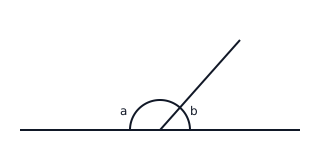
Angles on a straight line add up to . This is known as a supplementary angle relationship. If a straight line is divided into multiple angles at a point, their sum is always equal to a straight angle ().
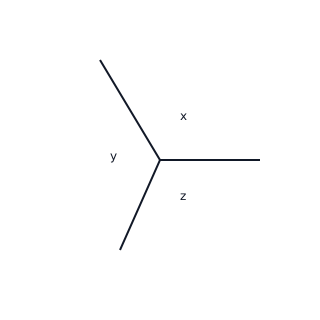
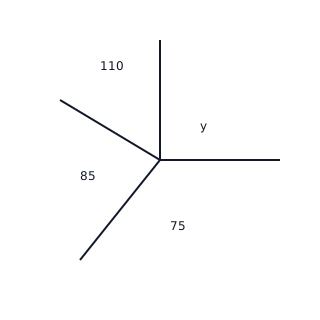
Angles around a point (a full turn) always sum to . Regardless of how many rays originate from a single vertex, the total rotation equals .
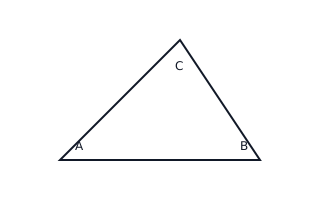
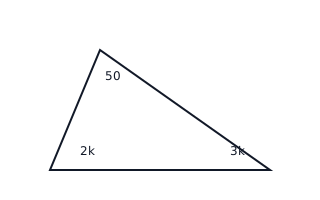
The sum of the interior angles of any triangle is always . This property holds true for scalene, isosceles, equilateral, and right-angled triangles.
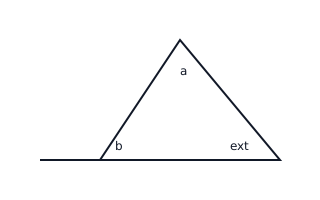
The exterior angle of a triangle is equal to the sum of the two opposite interior angles. This is a direct consequence of the triangle angle sum and straight line angle properties.
📐Formulae
💡Examples
Problem 1:
Calculate the value of if three angles on a straight line are given as , , and .
Solution:
- Use the property that angles on a straight line sum to : 2. Add the known values together: 3. Subtract from both sides to solve for : 4. The result is:
Explanation:
This problem is solved by identifying that the angles are supplementary because they sit on a straight line, meaning their total must be .
Problem 2:
An isosceles triangle has a vertex angle (the angle between the two equal sides) of . What is the size of each base angle?
Solution:
- Let each base angle be represented by . Since it is an isosceles triangle, both base angles are equal. 2. Set up the triangle sum equation: 3. Simplify the equation: 4. Subtract from both sides: 5. Divide by to find the value of one base angle:
Explanation:
In an isosceles triangle, we subtract the vertex angle from and divide the remainder by because the two remaining angles are equal.
Problem 3:
In the given diagram, four angles meet at a point. Three of the angles are , , and . Find the value of the fourth angle .
Solution:
Explanation:
Since the angles are at a point, they must sum to . By adding the known angles and subtracting from , we find the missing angle.
Problem 4:
Find the value of in the triangle shown, where the interior angles are , , and .
Solution:
Explanation:
The sum of interior angles in a triangle is . We set up an equation summing the three expressions to and solve for the unknown variable .