
Review the key concepts, formulae, and examples before starting your quiz.
🔑Concepts
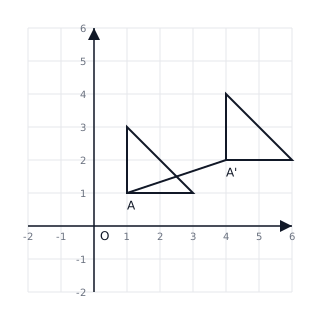
Geometric transformations describe how a shape moves or changes on a coordinate plane. Translation is a 'slide' where every point of a figure moves the same distance in the same direction. It is often represented by a column vector , where is the horizontal shift and is the vertical shift.
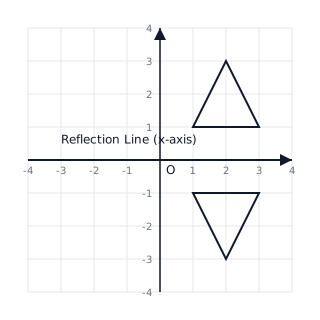
Reflection is a 'flip' over a line called the line of reflection. Each point and its image are equidistant from this line. For example, reflecting a point across the -axis changes its coordinates to .
Rotation is a 'turn' around a fixed point called the center of rotation. A rotation is defined by the center, the angle of rotation (e.g., or ), and the direction (clockwise or counter-clockwise).
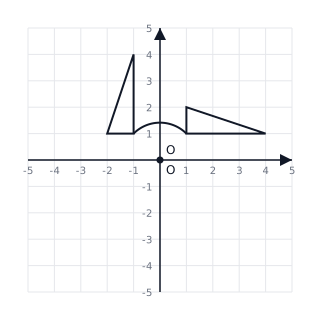
Transformation Invariance: Under translation, reflection, and rotation, the original shape (pre-image) and the final shape (image) are congruent. This means their side lengths and interior angles remain identical; only their position or orientation changes.
📐Formulae
Translation Rule: for a vector
Reflection in the -axis:
Reflection in the -axis:
Reflection in the line :
Rotation counter-clockwise about the origin:
Rotation about the origin:
Rotation counter-clockwise (or clockwise) about the origin:
💡Examples
Problem 1:
A triangle has vertices , , and . Translate this triangle using the vector and find the coordinates of the image.
Solution:
- Identify the translation values: (move 3 units left) and (move 4 units up).
- Apply the rule to each vertex:
- For :
- For :
- For :
- The coordinates of the image are , , and .
Explanation:
To translate a shape, we add the horizontal component of the vector to the -coordinates and the vertical component to the -coordinates of all vertices.
Problem 2:
Point is located at . Find the coordinates of the image after a reflection in the -axis, followed by a rotation of about the origin.
Solution:
Step 1: Reflect in the -axis. The rule for reflection in the -axis is . .
Step 2: Rotate the new point by about the origin. The rule for a rotation is . .
Final Answer: .
Explanation:
This is a composite transformation. We apply the first rule (reflection) to the original point to get an intermediate point, then apply the second rule (rotation) to that intermediate point to find the final image.
Problem 3:
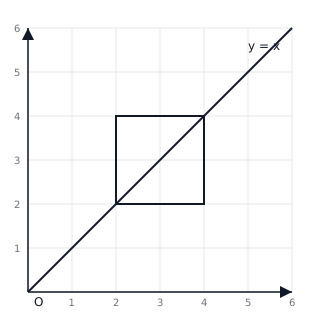
A square has vertices at , , , and . Reflect the square in the line . What are the coordinates of the vertices of the image ?
Solution:
Applying the rule for reflection in the line : .
Explanation:
Since the line passes through and , these points remain fixed (invariant). The points and swap positions across the diagonal line.
Problem 4:
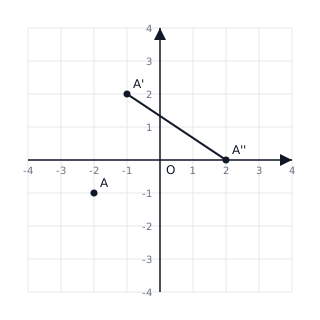
A point is at . Rotate point by clockwise about the origin to find , then translate using the vector to find . State the final coordinates of .
Solution:
Step 1: Rotate by clockwise (same as counter-clockwise). Rule: . .
Step 2: Translate by . . Final coordinates .
Explanation:
First, the rotation moves the point from the third quadrant to the second quadrant. Then, the translation moves the point 3 units right and 2 units down to the x-axis.