
Review the key concepts, formulae, and examples before starting your quiz.
🔑Concepts
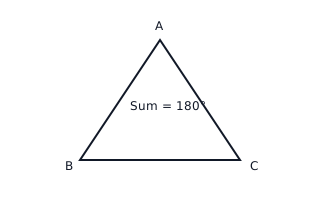
Triangles can be classified by their sides: Scalene (all sides different), Isosceles (two sides equal), and Equilateral (all three sides equal). They can also be classified by their angles: Acute, Obtuse, and Right-angled. The sum of interior angles in any triangle is always .
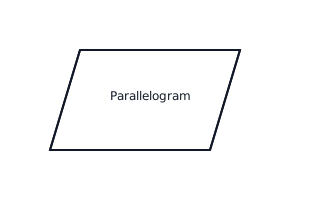
Quadrilaterals are four-sided polygons. The sum of their interior angles is . Specific types include Parallelograms (opposite sides parallel and equal), Rectangles (parallelogram with four angles), Rhombuses (parallelogram with four equal sides), and Squares (regular quadrilateral).
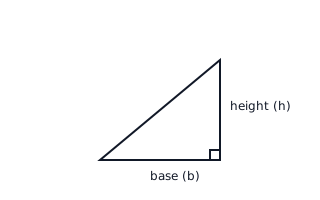
The area of a triangle is calculated using the perpendicular height () and the base (). Even if the triangle is obtuse, the height is the vertical distance from the vertex to the line containing the base.
A trapezium (or trapezoid) is a quadrilateral with at least one pair of parallel sides. The area is the average of the parallel sides multiplied by the height.
📐Formulae
Sum of angles in a triangle:
Sum of angles in a quadrilateral:
Area of a Triangle:
Area of a Rectangle:
Area of a Parallelogram:
Area of a Trapezium: , where and are parallel sides.
Perimeter of any 2D shape:
💡Examples
Problem 1:
In an isosceles triangle , the vertex angle is . Find the size of the two base angles, and .
Solution:
- Let the base angles be . Since it is an isosceles triangle, .
- The sum of angles is , so: .
- Simplify: .
- Subtract from both sides: .
- Divide by : . Final Answer: and .
Explanation:
This solution uses the property that base angles of an isosceles triangle are equal and the triangle angle sum theorem.
Problem 2:
Calculate the area of a trapezium where the parallel sides are and , and the perpendicular height is .
Solution:
- Identify the values: , , and .
- Use the formula: .
- Substitute the values: .
- Calculate inside the brackets: .
- Multiply: . Final Answer: The area is .
Explanation:
The area is found by taking the average of the parallel bases and multiplying by the vertical height between them.
Problem 3:
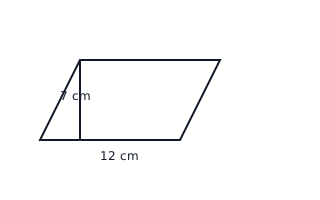
Calculate the area of the following parallelogram which has a base of and a perpendicular height of .
Solution:
- Identify the formula for the area of a parallelogram:
- Substitute the given values: and .
- Calculate:
- The area is .
Explanation:
The area of a parallelogram is simply the base multiplied by the vertical height, not the slant height of the sides.
Problem 4:
Find the value of the missing angle in a quadrilateral where the other three angles are , , and .
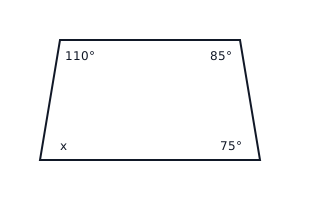
Solution:
- The sum of angles in a quadrilateral is .
- Set up the equation:
- Add the known angles: .
- Subtract from :
Explanation:
By applying the angle sum property of quadrilaterals, we can find any unknown angle if the other three are provided.