
Review the key concepts, formulae, and examples before starting your quiz.
🔑Concepts
Parallel lines are lines in the same plane that never intersect, no matter how far they are extended. Perpendicular lines are lines that intersect at a right angle, which is exactly . A transversal is a line that crosses at least two other lines.
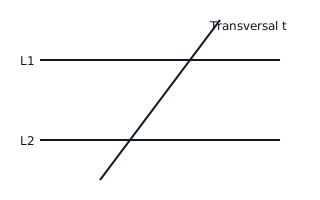
When two parallel lines are intersected by a transversal, Corresponding Angles are equal. These angles occupy the same relative position at each intersection where a straight line crosses two others.
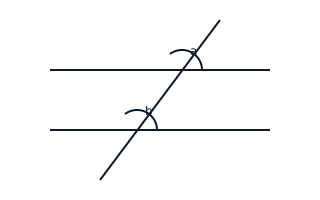
Alternate Interior Angles are located between the parallel lines and on opposite sides of the transversal. These angles are equal when the lines are parallel. Co-interior angles are on the same side of the transversal and between the parallel lines; they sum to (supplementary).
Perpendicularity is a special relationship where two lines meet to form four right angles. If a line is perpendicular to one of two parallel lines, it is also perpendicular to the other.
📐Formulae
If , then
If , then
If , then
For , the angle of intersection is
💡Examples
Problem 1:
In the diagram, line is parallel to line . A transversal line intersects at point and at point . If and are alternate interior angles, find the value of and the measure of each angle.
Solution:
- Since , alternate interior angles are equal: .
- Subtract from both sides: .
- Add to both sides: .
- Substitute back into the expressions: and .
Explanation:
Because the lines are parallel, we can use the property that alternate interior angles (the 'Z' shape) are equal in measure to set up an algebraic equation and solve for the unknown.
Problem 2:
Given two parallel lines intersected by a transversal, two co-interior angles are represented by and . Find the measure of the larger angle.
Solution:
- Co-interior angles between parallel lines are supplementary: .
- Combine like terms: .
- Divide by : .
- Find the larger angle: .
Explanation:
We use the co-interior angle property (the 'C' shape), which states that these angles sum to , to create a linear equation and solve for the variable.
Problem 3:
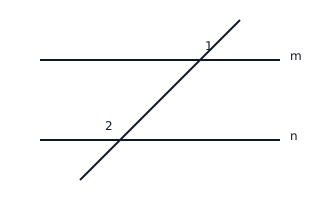
In the following figure, line is parallel to line . If , find the measure of .
Solution:
Explanation:
Angles 1 and 2 are related through parallel line properties. We can first find the linear pair for angle 1, then use the property that corresponding angles are equal, or use the property that co-interior angles sum to .
Problem 4:
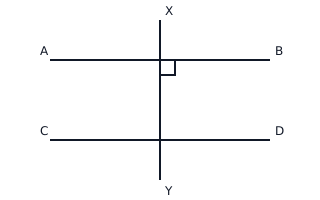
Lines and are parallel. A third line is perpendicular to at point . Does also intersect at a angle? Calculate the angle if .
Solution:
Explanation:
Using the property of corresponding angles, if a transversal (XY) intersects one of two parallel lines at , it must intersect the other at the same angle.