
Review the key concepts, formulae, and examples before starting your quiz.
🔑Concepts
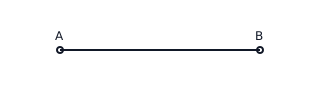
A line segment is a fixed portion of a line with two definite endpoints. The distance between these endpoints is called its length. For example, a segment has endpoints and .
Using a ruler and compasses is more accurate than using a ruler alone. To construct a segment of length , we fix the compass pointer at on the ruler and open the pencil arm to the mark.
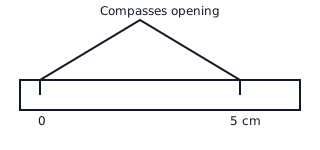
To copy a line segment without measuring its numerical length, place the compass pointer on and the pencil point on . Then, without changing the setting, draw an arc on a new line from a point to find point .
The difference between two segments and (where ) is a segment such that .
📐Formulae
If point lies between and :
If is the difference between and :
💡Examples
Problem 1:
Construct a line segment of length using a ruler and compasses.
Solution:
Step 1: Draw a line and mark a point on it. Step 2: Place the metal pointer of the compasses on the of the ruler. Step 3: Open the compasses so that the pencil point rests on the mark ( and small millimeter divisions). Step 4: Without changing the opening of the compasses, place the pointer on point and swing an arc to cut the line at point . Step 5: is the required line segment of length .
Explanation:
This method is preferred over using just a ruler because the compass preserves the exact length while transferring it to the paper, reducing the chances of manual error while marking points.
Problem 2:
Given two line segments and , construct a segment such that .
Solution:
Step 1: Draw a long line and mark a point on it. Step 2: Open the compasses to measure the length of (). Step 3: Place the pointer at and draw an arc to cut line at a point, let's call it . Now . Step 4: Open the compasses to measure the length of (). Step 5: Place the pointer at (the end of the first segment) and draw an arc in the same direction to cut line at point . Step 6: The total length .
Explanation:
To add two line segments, we place them end-to-end on a single line. The distance from the starting point of the first segment to the ending point of the second segment represents the sum.
Problem 3:
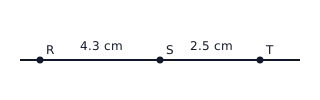
Construct a line segment of length and then construct another segment of length such that are collinear and lies between and . Find the total length .
Solution:
- Draw a line and mark a point .
- Using a ruler and compasses, mark point at a distance of from .
- From point , mark point at a distance of further along the line.
- The total length .
Explanation:
By the segment addition property, if is between and , the total distance is the sum of the individual parts.
Problem 4:
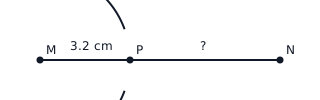
Given a line segment of length , construct a point on it such that . Calculate the length of the remaining part .
Solution:
- Draw of length .
- Set the compasses to .
- Place the pointer at and draw an arc cutting at point .
- .
Explanation:
When a point is placed on a segment , it divides the segment into two parts. The length of one part is the total length minus the length of the other part.