
Review the key concepts, formulae, and examples before starting your quiz.
🔑Concepts
To copy a line segment onto a new line , we use a compass to 'measure' the distance between and instead of a ruler. This ensures higher precision by transferring the exact physical span to a new location.
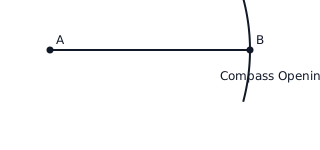
Once the compass is set to the length of , fix the pointer at a point on a line . Draw an arc that intersects the line at point . The segment is then congruent to , written as .
The ruler is used only to draw the initial straight line and to provide a straight edge; the compass is the primary tool for transferring the specific length without reading numerical values.
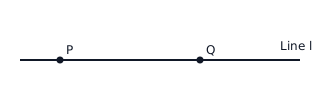
Key Steps: 1. Draw a line . 2. Mark point on it. 3. Place compass pointer on and pencil on . 4. Without changing the compass width, place pointer on and swing an arc to cut at .
📐Formulae
💡Examples
Problem 1:
Given a line segment of length cm, construct a copy using only a ruler and a compass.
Solution:
- Draw a line and mark a point on it.
- Place the compass pointer on point of the given segment and open it until the pencil tip reaches point .
- Maintaining the same compass width, place the metal pointer on point on line .
- Draw an arc that cuts the line at a point, and name it .
- The segment is the required copy of , such that cm.
Explanation:
The compass acts as a physical measurement transfer tool, ensuring that the distance between and is identical to the distance between and without needing to read numerical values on a ruler twice.
Problem 2:
If a line segment is given, how can you construct a segment whose length is twice that of ?
Solution:
- Draw a long line and mark a point on it.
- Measure the length of the given segment using a compass (pointer on , pencil on ).
- Place the compass pointer on and mark an arc on line to get point . Now .
- Without changing the compass width, move the pointer to point and mark another arc further along the line to get point .
- The segment is the required segment where .
Explanation:
This construction uses the addition of segments property. By placing two copies of the same segment end-to-end on a straight line, the total length becomes .
Problem 3:
Given two line segments and , construct a line segment such that the length of is equal to the sum of the lengths of and .
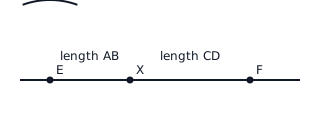
Solution:
- Draw a line and mark a point on it.
- Open the compass to match the length of .
- Place the compass pointer on and mark an arc on line to find point .
- Now, open the compass to match the length of .
- Place the pointer on and mark another arc on line (away from ) to find point .
- is the required segment where .
Explanation:
This method uses the property of addition of segments by placing them end-to-end (adjacent) on the same line.
Problem 4:
Given a line segment of length cm and of length cm, construct a segment equal to the difference .
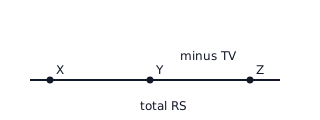
Solution:
- Draw a line and mark point on it.
- Adjust the compass to the length of and mark point from on the line.
- Adjust the compass to the length of .
- Place the pointer on and mark an arc back towards . The point where it cuts the line is .
- The segment represents .
Explanation:
To find the difference, we first layout the larger segment and then 'cut back' the length of the smaller segment.