
Review the key concepts, formulae, and examples before starting your quiz.
🔑Concepts
A circle is a collection of all points in a plane that are at a constant distance from a fixed point. The fixed point is called the center (), and the constant distance is called the radius ().
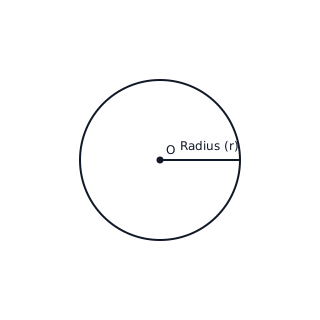
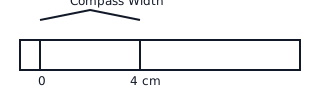
To construct a circle of a given radius (e.g., ), open the compass using a ruler so that the pointer and the pencil lead are apart.
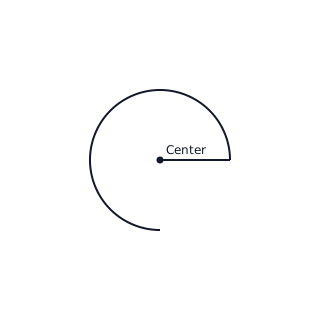
The center of the circle is marked with a sharp pencil as a point. The metal pointer of the compass is placed exactly on this point while the pencil traces the circumference.
Concentric circles are circles that share the same center point but have different radii. To draw them, keep the compass pointer at the same spot but change the opening for each new circle.

📐Formulae
💡Examples
Problem 1:
Construct a circle of radius using a ruler and compass.
Solution:
Step 1: Open the compass and use a ruler to set the distance between the metal pointer and the pencil tip to exactly .\nStep 2: Mark a point on the paper to serve as the center of the circle.\nStep 3: Place the metal pointer of the compass on point .\nStep 4: Turn the compass slowly to draw the full curve, ensuring the pointer does not shift from . The resulting shape is the required circle with .
Explanation:
The construction relies on keeping the distance between the pointer and pencil constant to ensure every point on the boundary is exactly from the center .
Problem 2:
If the diameter of a circle is , find its radius and explain how to adjust the compass to draw it.
Solution:
Step 1: Use the formula . Given , the radius is .\nStep 2: To draw this circle, place the metal tip of the compass at the mark on a ruler and extend the pencil tip to the mark.\nStep 3: Fix a center point and rotate the compass to complete the circle.
Explanation:
Since a compass is set using the radius, we must first divide the diameter by before we can begin the construction process.
Problem 3:
Construct two concentric circles with a common center and radii and .
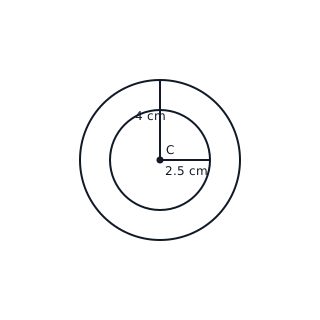
Solution:
- Mark a point and label it .
- Set the compass to a radius of using a ruler.
- Place the pointer on and draw the first circle.
- Without moving the center point, adjust the compass to .
- Draw the second circle around the first one.
Explanation:
Concentric circles are drawn by maintaining the same center while varying the distance between the compass needle and the pencil.
Problem 4:
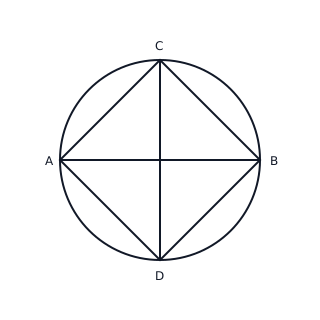
Draw a circle and any two of its diameters. If you join the ends of these diameters, what is the shape formed?
Solution:
- Draw a circle with center .
- Draw two diameters and .
- Join to , to , to , and to .
- The resulting shape is a rectangle.
Explanation:
In a circle, diameters are equal and bisect each other at the center. When we join the endpoints of two diameters, the diagonals of the resulting quadrilateral are equal and bisect each other, which is the property of a rectangle.