
Review the key concepts, formulae, and examples before starting your quiz.
🔑Concepts
The angle is the foundational construction in practical geometry. By drawing an arc with a compass and then, without changing the radius, drawing a second arc from the point where the first arc intersects the base line, you create an equilateral triangle's vertex, which is exactly .
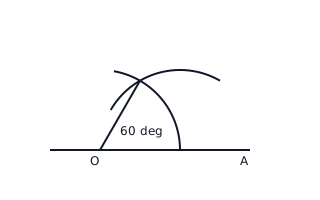
An angle of is constructed by marking two consecutive arcs on a large primary arc. Since , the second intersection point from the base line represents from the starting ray.
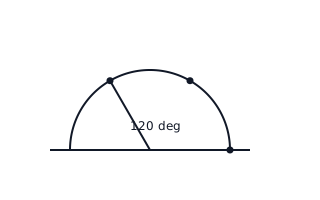
A angle (perpendicular) can be constructed by bisecting the angle between and . Because is exactly halfway between and , we use the intersection points of these two arcs to find the vertical line.
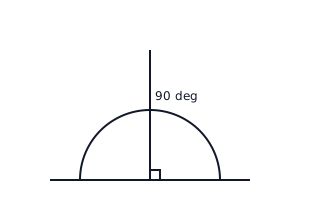
Sub-angles like and are created through angle bisector techniques. is the bisector of a angle, and is the bisector of a angle.
📐Formulae
💡Examples
Problem 1:
Construct an angle of at the endpoint of a ray .
Solution:
- Draw a ray . 2. With as center and any convenient radius, draw an arc intersecting at point . 3. With as center and the same radius as before, draw an arc intersecting the first arc at point . 4. Draw a ray passing through . 5. The measure of is .
Explanation:
This construction uses the property of an equilateral triangle. Since the radius (distance from to , to , and to ) is kept constant, would be equilateral, meaning all angles are .
Problem 2:
Construct an angle of and use it to construct a angle.
Solution:
- Draw a line and mark a point on it. 2. Draw a semi-circle arc with center cutting the line at and . 3. From , mark the arc and then the arc. 4. Bisect the space between and to find the ray, . 5. To get , place the compass at the point where the arc hits the horizontal line and where it hits the ray . 6. Draw two arcs that intersect at point and join . .
Explanation:
We first create a perpendicular () by finding the midpoint between and . Then, we apply the angle bisector method to the angle to halve it into .
Problem 3:
Construct an angle of using only a compass and ruler.
Solution:
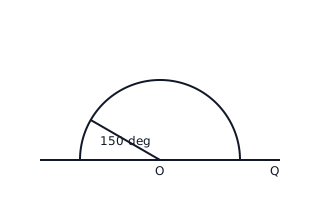
- Draw a line segment and mark point on it.
- Construct a angle and a angle (straight line) on the same arc.
- Bisect the angle between and because .
- The resulting ray makes an angle .
Explanation:
To construct , we identify that it lies exactly halfway between and . By bisecting that gap, we add to .
Problem 4:
Construct an angle of using a compass and a ruler.
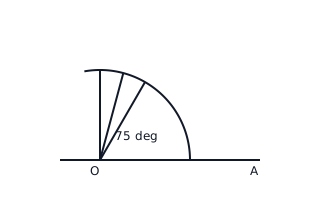
Solution:
- Draw a ray .
- Construct a angle and a angle on the same primary arc.
- The space between and is .
- Bisect this interval to get .
- . The ray passing through this bisector forms .
Explanation:
A angle is found by bisecting the region between the and construction marks.