
Review the key concepts, formulae, and examples before starting your quiz.
🔑Concepts
An angle bisector is a ray that originates from the vertex of an angle and divides it into two equal parts. If ray bisects , then .
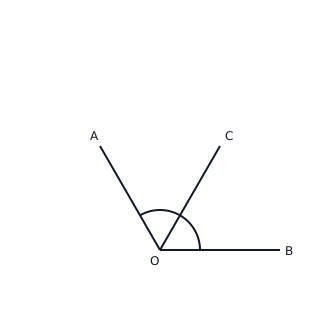
To construct an angle bisector using a compass, we draw an arc from the vertex to intersect both arms at points and . Then, from and , we draw arcs with the same radius that intersect at a point in the interior of the angle.
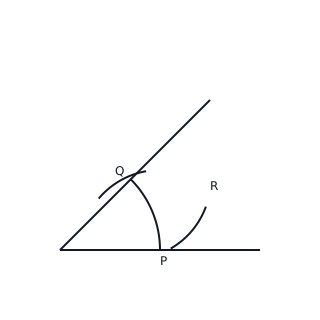
The bisector is always the axis of symmetry for the angle, meaning if you fold the paper along the bisector, the two arms of the angle will overlap perfectly.
If we bisect an angle and then bisect the resulting angles again, we divide the original angle into four equal parts.
📐Formulae
💡Examples
Problem 1:
If and ray is its angle bisector, find the measure of .
Solution:
- Identify the given total angle: .
- Since is the bisector, it divides the angle into two equal parts.
- Use the formula: .
- Substitute the value: .
- Therefore, .
Explanation:
The problem applies the fundamental property that an angle bisector divides the total angle into two equal halves.
Problem 2:
A student constructs a bisector for . If the measure of is found to be , what was the original measure of ?
Solution:
- We are given the measure of one of the bisected parts: .
- Since is the bisector, the whole angle is twice the measure of one part.
- Use the formula: .
- Calculate: .
- The original angle measured .
Explanation:
This example demonstrates how to find the total angle when the measure of a bisected part is known by multiplying by .
Problem 3:
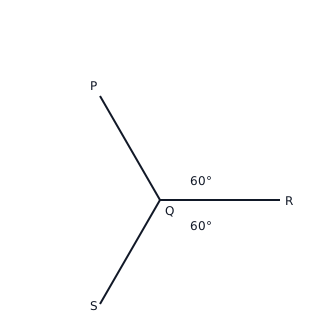
Given , if ray is the bisector of , find the measure of .
Solution:
- Measure of the original angle .
- Since is the bisector, it divides the angle into two equal parts.
Explanation:
The angle bisector property states that each resulting angle is exactly half of the original angle's measure.
Problem 4:
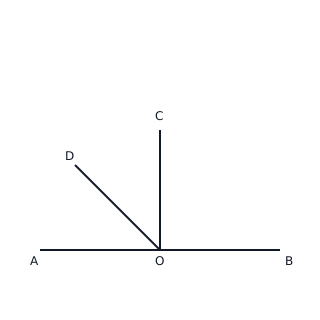
In the figure, is a straight angle (). Ray is perpendicular to , and ray bisects . Find the measure of .
Solution:
- (since ).
- (linear pair with ).
- Since bisects , .
Explanation:
We first find the half-measure of the right angle and then add it to the adjacent right angle to find the total measure.